4.5/5
4.5/5





World Ozone Day : 16th September 2026
World Ozone Day : 16th September 2026
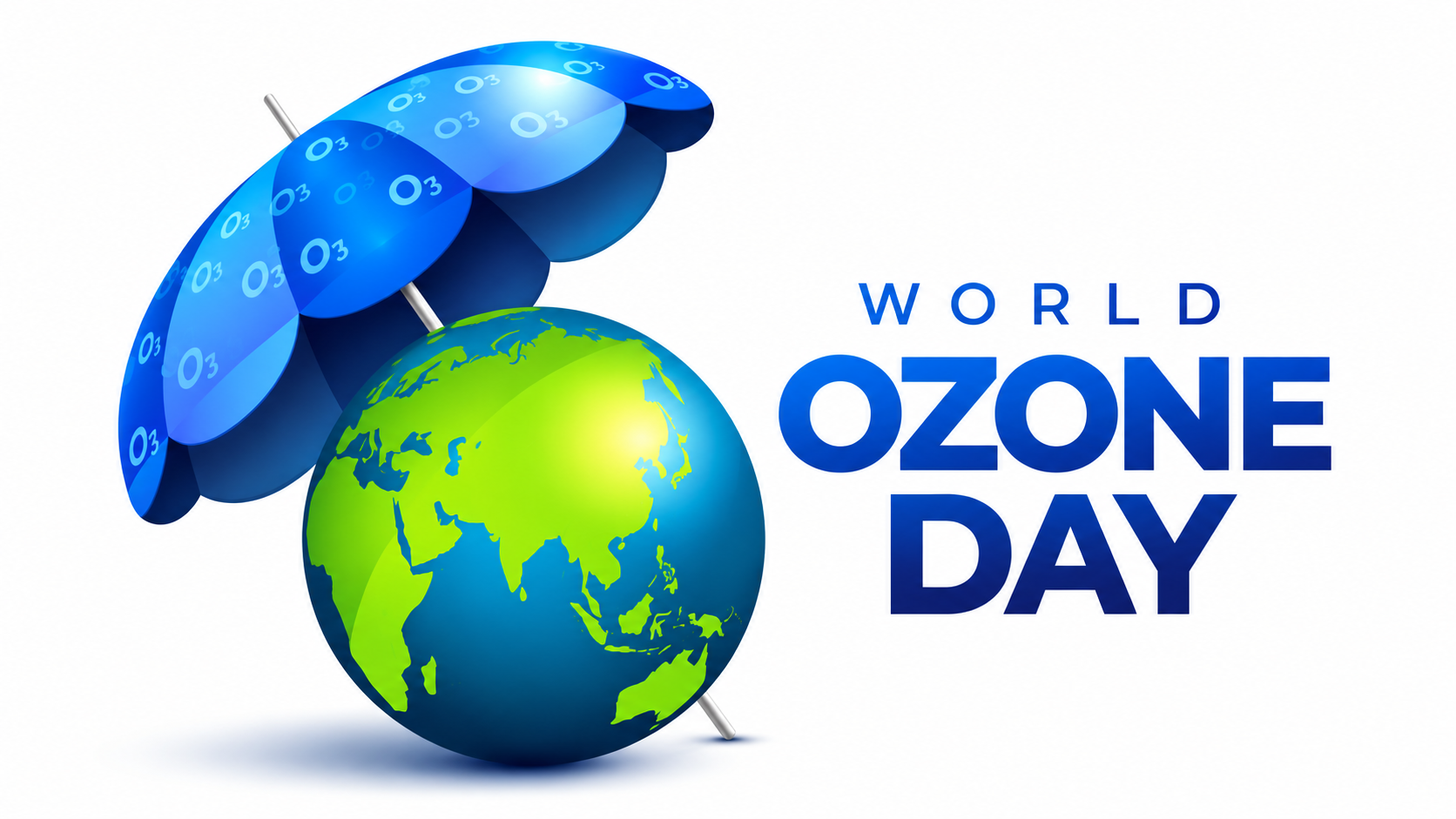
World Ozone Day is observed every year on 16 September to spread awareness about protecting the ozone layer, the natural shield that guards life on Earth from harmful ultraviolet radiation. In 2026, this global observance holds extra importance as it marks ten years of progress in sustainable cooling efforts linked to the Montreal Protocol.
World Ozone Day is observed every year on 16 September to spread awareness about protecting the ozone layer, the natural shield that guards life on Earth from harmful ultraviolet radiation. In 2026, this global observance holds extra importance as it marks ten years of progress in sustainable cooling efforts linked to the Montreal Protocol.
Key Facts About World Ozone Day
-
World Ozone Day is a UN-recognised observance dedicated to protecting the stratospheric ozone layer.
-
It is celebrated on a fixed date every year, 16 September, making it easy for schools and institutions to plan activities.
- The day is closely connected to the Montreal Protocol, a global treaty aimed at reducing ozone-depleting substances.
- It highlights how international cooperation can successfully solve major environmental problems.
World Ozone Day Theme 2026
The theme for this year is "Global Action for a Cooler Planet – Celebrating 10 Years of Sustainable Cooling under the Kigali Amendment to the Montreal Protocol." This theme reflects on a decade of achievements made through the Kigali Amendment, which focuses on reducing harmful greenhouse gases while continuing to protect the ozone layer.
The theme for this year is "Global Action for a Cooler Planet – Celebrating 10 Years of Sustainable Cooling under the Kigali Amendment to the Montreal Protocol." This theme reflects on a decade of achievements made through the Kigali Amendment, which focuses on reducing harmful greenhouse gases while continuing to protect the ozone layer.
Why Is World Ozone Day Celebrated?
-
It explains how the ozone layer shields living beings from harmful ultraviolet radiation.
- It teaches students and communities about the causes and effects of ozone depletion.
- It highlights the Montreal Protocol as one of the most successful examples of global environmental action.
- It connects ozone protection with human health, ecosystems, and climate change.
- It encourages people to adopt sustainable habits and make responsible environmental choices.
History of World Ozone Day
The Vienna Convention, the Montreal Protocol, and the Kigali Amendment show how global cooperation has evolved over decades to protect the environment, making World Ozone Day a meaningful reminder of what collective action can achieve.
The Vienna Convention, the Montreal Protocol, and the Kigali Amendment show how global cooperation has evolved over decades to protect the environment, making World Ozone Day a meaningful reminder of what collective action can achieve.
|
Agreement
|
Year
|
Key Facts
|
|---|---|---|
|
Vienna Convention for the Protection of the Ozone Layer
|
1985
|
Adopted in 1985; entered into force in 1988. Focused on research, monitoring and international cooperation to protect the ozone layer. No binding reduction targets for ODS.
|
|
Montreal Protocol
|
1987
|
Adopted on 15 September 1987. Controls/phases out nearly 100 ozone-depleting substances (ODS). Universally ratified by all UN-recognised countries. Ozone layer is expected to recover to pre-1980 levels by around 2040–2066, depending on region.
|
|
Kigali Amendment
|
2016
|
Adopted in Kigali, Rwanda, in 2016; entered into force in 2019. Targets HFCs (hydrofluorocarbons), which are powerful greenhouse gases but do not deplete ozone. Could help avoid up to 0.4°C of warming by 2100.
|
Ozone
- The ozone layer, located in the stratosphere between 10 and 40 kilometers above Earth's surface, shields us from harmful UV radiation.
- This protective layer, known as stratospheric ozone or good ozone , prevents adverse health effects like cataracts and skin cancer and safeguards agriculture, forestry, and marine life.
- However, man-made Ozone Depleting Substances have caused ozone depletion in the stratosphere.
- The international community recognized the need for action, leading to the Vienna Convention in 1985 and the subsequent Montreal Protocol in 1987.
- The inclusion of Hydrofluorocarbons (HFCs) in the Montreal Protocol led to the Kigali Amendment, with India ratifying it in September 2021.
- Ozone (composed of three atoms of oxygen) occurs both in the Earth's upper atmosphere (stratosphere) and at ground level (troposphere). It can be good or bad, depending on where it is found.
- Good Ozone: Ozone occurs naturally in the Earth's upper atmosphere (Stratosphere) where it forms a protective layer that shields us from the sun's harmful ultraviolet rays.
- Bad Ozone: In the Earth's lower atmosphere (troposphere) near ground level, ozone is formed when pollutants emitted by cars, power plants, industrial boilers, refineries, chemical plants, and other sources react chemically in the presence of sunlight.
Ozone-depleting substances
Ozone is produced naturally in the stratosphere. But this “good” ozone is gradually being destroyed by man-made chemicals referred to as ozone-depleting substances (ODS).
Ozone-depleting substances are chemicals that destroy the earth’s protective ozone layer. They include:
- chlorofluorocarbons (CFCs)
- halon
- carbon tetrachloride (CCl4)
- methyl chloroform (CH3CCl3)
- hydro Bromo fluorocarbons (HBFCs)
- hydrochlorofluorocarbons (HCFCs)
- methyl bromide (CH3Br)
- bromochloromethane (CH2BrCl)
0 like |
0 comment