4.5/5
4.5/5





World Coconut Day : 2 Sept 2026
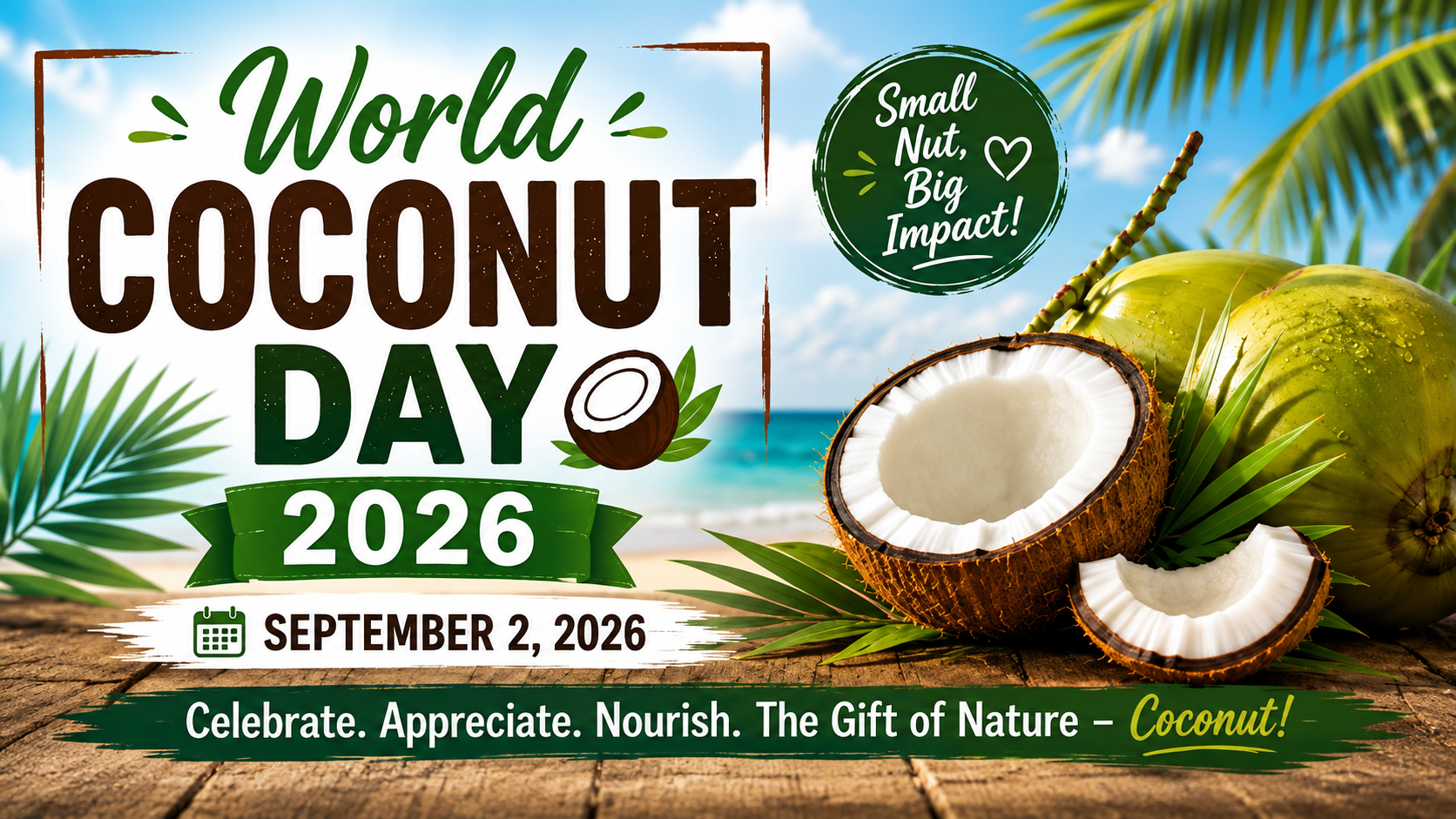
World Coconut Day : 2 Sept 2026
-
World Coconut Day 2026 will be observed on Wednesday, September 2, 2026. Coconuts play a major role in food, agriculture, livelihoods, and trade across dozens of tropical countries, and this annual observance exists to raise awareness of that role.
What Is the World Coconut Day 2026 Theme?
- Multiple sources are reporting the World Coconut Day 2026 theme as “Coconut for a Circular Economy: Building Partnership for Maximum Value.” This theme has also been associated with the observance in recent prior years, so it should be treated as provisional rather than confirmed. The official theme for each year is set by the International Coconut Community (ICC), formerly the Asian and Pacific Coconut Community (APCC).
About India’s Coconut Sector
- Coconut, regarded as the “Kalpavriksha” or tree of life, has been part of India’s culture and agrarian economy for nearly three thousand years. Its diverse uses in food, drink, medicine, fibre, timber and fuel have also supported the growth of a modern value-added coconut industry.
- Around 30 million people, including about 10 million farmers, depend on the coconut sector, with cultivation largely undertaken by small and marginal farmers.
- India ranks first globally in coconut production and third in area under cultivation, accounting for 31.24% of global production and 17.90% of global area, respectively.
- During 2024-25, India produced 20,301.22 million nuts from 2.19 million hectares, with average productivity of 9,249 nuts per hectare.
Major Coconut-Producing States
The distribution of coconut cultivation and productivity varies considerably across States.
The distribution of coconut cultivation and productivity varies considerably across States.
- Keralam has the largest area under coconut cultivation, covering nearly 7.54 lakh hectares and producing about 5,149.87 million nuts.
- Tamil Nadu leads the country in coconut production.
- Andhra Pradesh records the highest productivity, followed by West Bengal and Tamil Nadu.
- Coconut cultivation is also expanding into newer areas, with Bastar in Chhattisgarh emerging as an example of coconut-based multi-tier farming integrated with fruits, vegetables and other crops.
From Traditional Commodity to Export-Oriented Sector
- India’s coconut industry has increasingly shifted from traditional products towards value-added products and diversified export markets.
- Exports increased from just ₹25.3 crore in 2001-02 to ₹7,038.35 crore (USD 794.70 million) in 2025-26.
- The export basket has diversified into virgin coconut oil, coconut milk, coconut water and activated carbon, besides fresh, frozen and grated coconut.
- India’s coconut products have expanded beyond the traditional Middle East market to Europe, the Americas and Australia.
- Major trading partners during the last five years include the United States of America, United Arab Emirates, Sri Lanka, Germany, Russia, Turkey, Belgium, United Kingdom and the Netherlands.
Government Initiatives for the India’s Coconut Sector
The Government is strengthening the coconut sector across the entire value chain, from quality planting material and cultivation to productivity improvement, rejuvenation, processing, exports, skill development and farmer incomes.
The Government is strengthening the coconut sector across the entire value chain, from quality planting material and cultivation to productivity improvement, rejuvenation, processing, exports, skill development and farmer incomes.
Coconut Development Board
- The Coconut Development Board (CDB) is the main institutional body for the integrated development of coconut cultivation and industry in India.
- Established on 12 January 1981, the CDB functions under the Ministry of Agriculture and Farmers Welfare and is headquartered in Kochi.
- It works across 22 States/Union Territories with focus on quality planting material, expansion of cultivation, productivity improvement, pest and disease management, product diversification and by-product utilisation.
- During 2025-26, ₹147.21 crore was released for activities implemented under the Board.
Minimum Support Price for Copra
- The Government provides price support for copra to improve returns to coconut growers.
- Copra, the dried kernel of coconut, is one of the 22 crops covered under the Minimum Support Price (MSP) regime.
- For the 2026 season, MSP has been fixed at ₹12,027 per quintal for milling copra and ₹12,500 per quintal for ball copra.
- The National Agricultural Cooperative Marketing Federation of India Limited (NAFED) and National Cooperative Consumers’ Federation of India Limited (NCCF) are the Central Nodal Agencies for copra procurement, along with State-level agencies.
India’s Position in Global Coconut Economy
- India ranks 1st in the world in coconut production.
-
India ranks 3rd in coconut cultivation area.
-
India contributes 31.24% of global coconut production.
-
India accounts for 17.90% of global coconut cultivation area.
-
Coconut production in 2024–25: 20,301.22 million nuts.
-
Coconut cultivation area in 2024–25: 2.19 million hectares.
-
Average productivity: 9,249 nuts/hectare.
-
Kerala: Largest area under coconut cultivation.
-
Tamil Nadu: Highest coconut production.
-
Andhra Pradesh: Highest productivity.
FACTS
-
Coconut husk is made up of sclerenchymatous tissue.
-
Coconut is propagated through seedlings raised from selected seednuts.
-
Coconut is a plantation crop.
Plantation Commodity Boards – HQ
|
Board
|
Headquarters
|
|---|---|
|
Coconut Development Board (CDB)
|
Kochi, Kerala
|
|
Tea Board of India
|
Kolkata, West Bengal
|
|
Coffee Board of India
|
Bengaluru, Karnataka
|
|
Rubber Board of India
|
Kottayam, Kerala
|
|
Tobacco Board
|
Guntur, Andhra Pradesh
|
|
Spices Board of India
|
Kochi, Kerala
|
|
Coir Board
|
Kochi, Kerala
|
0 like |
0 comment