4.5/5






VISTAR Scheme 2026-31: Cabinet Approves ₹4,371.10 Crore for Statistical Transformation
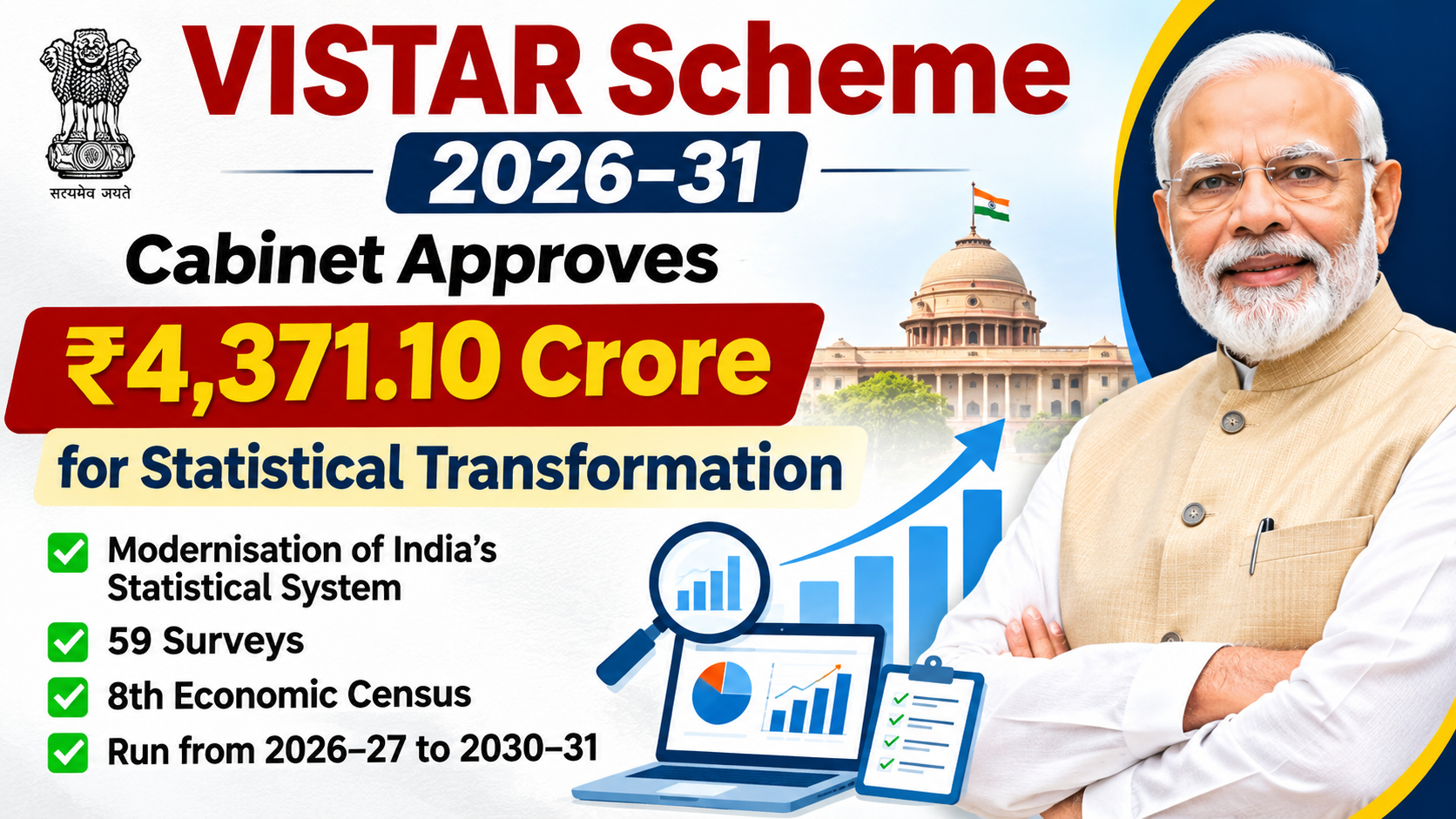
VISTAR Scheme 2026-31: Cabinet Approves ₹4,371.10 Crore for Statistical Transformation
|
Particular
|
Details
|
|
Scheme name
|
VISTAR
|
|
Full form
|
Viksit Bharat Initiative for Statistical Transformation, Analytics & Research
|
|
Approved by
|
Union Cabinet
|
|
Approval date
|
4 November 2026
|
|
Total outlay
|
₹4,371.10 crore
|
|
Duration
|
2026–27 to 2030–31
|
|
Type
|
Central Sector Scheme
|
|
Nodal Ministry
|
Ministry of Statistics and Programme Implementation (MoSPI)
|
|
Main objective
|
Modernisation of India's statistical system
|
2. Three Major Components
1. Comprehensive Statistical Operations and Strengthening of Ecosystem
-
Conduct 59 surveys instead of 43 major surveys previously.
-
Use AI and Machine Learning for data processing and analysis.
-
Introduce new economic indicators.
-
Use mobile phone, scanner and e-commerce data.
2. Support for Statistical Strengthening (SSS 2.0)
-
Financial and technical support to States and UTs.
-
Improve district-level GDP estimates.
-
Improve statistical infrastructure.
-
Develop million-plus city-level estimates.
3. Economic Census (EC)
-
Conduct the 8th Economic Census.
-
Collect information about non-farm establishments and workers.
-
Data collection up to Gram Panchayat and Ward level.
-
Establish a baseline for the National Statistical Business Register (SBR).
3. New Statistical Indicators
-
Headline Index of Services Production.
-
Index of Unincorporated Sector Enterprises.
Bharat VISTAAR vs VISTAR Scheme: Key Differences
|
Bharat VISTAAR
|
VISTAR Scheme
|
|
Agriculture and AI
|
Statistical transformation
|
|
Farmer-focused
|
Statistical system-focused
|
|
Ministry of Agriculture
|
MoSPI
|
|
Agricultural advisory platform
|
Statistical modernisation scheme
|
Bharat VISTAAR (2026)
Bharat VISTAAR stands for Virtually Integrated System to Access Agricultural Resources.
-
Launched by: Government of India.
-
Ministry: Ministry of Agriculture and Farmers Welfare.
-
Type: AI-powered multilingual digital platform.
-
Main objective: To provide farmers with easy access to agricultural information and advisory services.
-
Technology: Artificial Intelligence (AI) and Digital Public Infrastructure.
-
Language support: Multilingual access for farmers.
-
Key features:
-
Provides AI-based agricultural advice.
-
Offers crop-specific recommendations.
-
Provides weather-related information.
-
Helps farmers access government schemes.
-
Provides information about agricultural markets.
-
Supports informed farming decisions.
-
-
Main beneficiaries: Indian farmers.
-
Aim: To improve agricultural productivity, efficiency and farmers' income.
0 like |
0 comment