4.5/5
4.5/5





RBI Revises InvIT, REIT Valuation Norms for All-India Financial Institutions
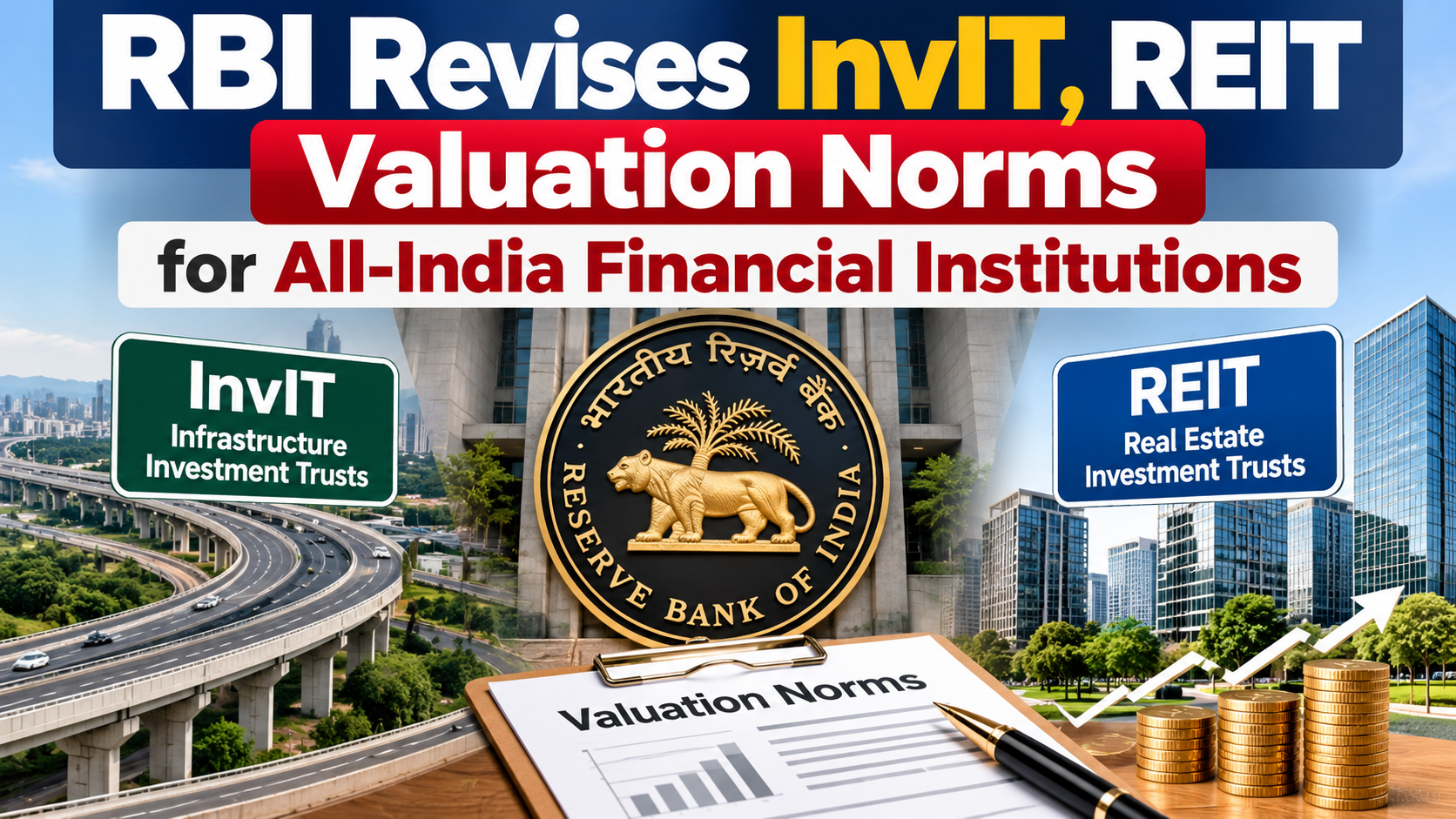
RBI Revises InvIT, REIT Valuation Norms for All-India Financial Institutions
-
The Reserve Bank of India (RBI) issued the RBI (All India Financial Institutions – Classification, Valuation and Operation of Investment Portfolio) Amendment Directions, 2026. The amendment aims to bring clarity and uniformity in the valuation of InvIT and REIT investments held by All-India Financial Institutions (AIFIs).
What Have Been Amended by RBI for InvIT and REIT Units?
The RBI has made two additions to Chapter VI of its investment portfolio directions.
The RBI has made two additions to Chapter VI of its investment portfolio directions.
- Paragraph 58A relates to InvIT units.
- Paragraph 58B relates to REIT units.
Valuation of InvIT Units Under New RBI Guidelines
|
InvIT Investments
|
Value Method
|
|---|---|
|
Quoted InvIT Units
|
As per existing RBI guidelines for quoted securities
|
|
Unquoted InvIT Units
|
NAV reported by InvIT
|
|
Failure to Report NAV
|
₹1 per unit
|
|
Infrequently Traded InvIT Units
|
₹1 per unit
|
New REIT Valuation Norms
- The RBI has put into place a fairly comparable structure for the valuation of Real Estate Investment Trusts (REITs).
- Units of REITs that are quoted will be valued in accordance with the RBI instructions applicable to quoted securities.
- In the case of unquoted REIT units, the AIFIs will value the units based on the NAV reported by the REIT.
- If any REIT is unable to calculate and disclose NAV as per the methodology and periodicity laid down in the SEBI (Real Estate Investment Trusts) Regulations, 2014, then the units will be valued at ₹1 under the RBI directions.
REIT Valuation Under the New RBI Norms
|
REIT Investments
|
Value Method
|
|---|---|
|
Quoted REIT Units
|
RBI instructions for quoted securities
|
|
Unquoted REIT Units
|
NAV reported by REIT
|
|
Failure to Report NAV
|
₹1 per unit
|
|
Infrequently Traded REIT Units
|
₹1 per unit
|
Infrastructure Investment Trust (InvIT)
-
Definition: It is an investment vehicle, like a mutual fund or Real Estate Investment Trust (REITs).
-
InvITs enable direct investment of money from individual and institutional investors in infrastructure projects.
-
Investments can be made directly or through SPV (Special Purpose Vehicle)/Holding Company by the InvIT.
-
-
InvITs earn income through tolls, rents, interest or dividends from their investments.
-
The interest, dividend, and rental income are taxable in the hands of the unitholder.
-
-
Regulation: InvITs are regulated by SEBI under the SEBI (Infrastructure Investment Trusts) Regulations, 2014.
-
SEBI requires InvITs to distribute at least 90% of their income to investors.
-
InvITs are recognized as borrowers under the ‘Securitization and Reconstruction of Financial Assets and Enforcement of Security Interest Act, 2002’.
-
-
Types of InvITs: Public InvITs, Private Listed InvITs and Private Unlisted InvITs.
-
Advantages of InvITs: Access to retail investors to invest in large infrastructure projects, low ticket size, liquidity (as units are listed on stock exchanges), etc.
-
Any dividend or interest income earned from InvITs is fully taxable according to the investor’s applicable income tax slab rate.
-
InvITs are specifically recognized as borrowers under the SARFAESI Act (Securitization and Reconstruction of Financial Assets and Enforcement of Security Interest Act, 2002), which primarily deals with the securitization and enforcement of security interests by financial institutions.
-
First Public InvIT: The first Public InvIT is planned for launch in 2026, following cumulative monetisation of ₹1.52 lakh crore through Toll-Operate-Transfer (ToT) and private InvITs.
-
National Highways Infra Trust (NHIT): It was set up by the National Highways Authority of India (NHAI) in 2020. NHIT concluded its fourth fundraising round at an enterprise value of ₹18,380 crore.It was the largest monetisation transaction in India’s road sector. In January 2026, NHAI-sponsored Raajmarg Infra Investment Trust (RIIT) received a AAA (Stable) rating from CARE Ratings Limited.
-
POWERGRID InvIT: In September 2020, the Government approved monetisation of POWERGRID’s assets through the InvIT model.
Real Estate Investment Trust (REIT)
-
REIT is an entity created to channel investible funds into operating, owning or financing income-producing real estate.
-
REITs are modeled on mutual funds and provide investors with a liquid way to invest in real estate.
-
REITs provide investors with:
-
Regular income
-
Portfolio diversification
-
Long-term capital appreciation
-
-
REITs can be listed on stock exchanges.
-
In India, REITs were introduced by SEBI in 2007.
-
Union Budget 2026–27: The Budget announced the creation of dedicated REITs for Central Public Sector Enterprises (CPSEs).
-
InvITs and REITs are recognised as “borrowers” under the Securitisation and Reconstruction of Financial Assets and Enforcement of Security Interest (SARFAESI) Act, 2002.
-
Interest income from REITs is taxable in the hands of the unit holder and is generally taxed according to the applicable income-tax slab rate.
-
Dividend income from REITs is taxable in the hands of the unit holder and is generally taxed at the applicable income-tax slab rate.
0 like |
0 comment