4.5/5
4.5/5





Punjab Assembly Passes Guru Granth Sahib Satkar Bill
Punjab Assembly Passes Guru Granth Sahib Satkar Bill
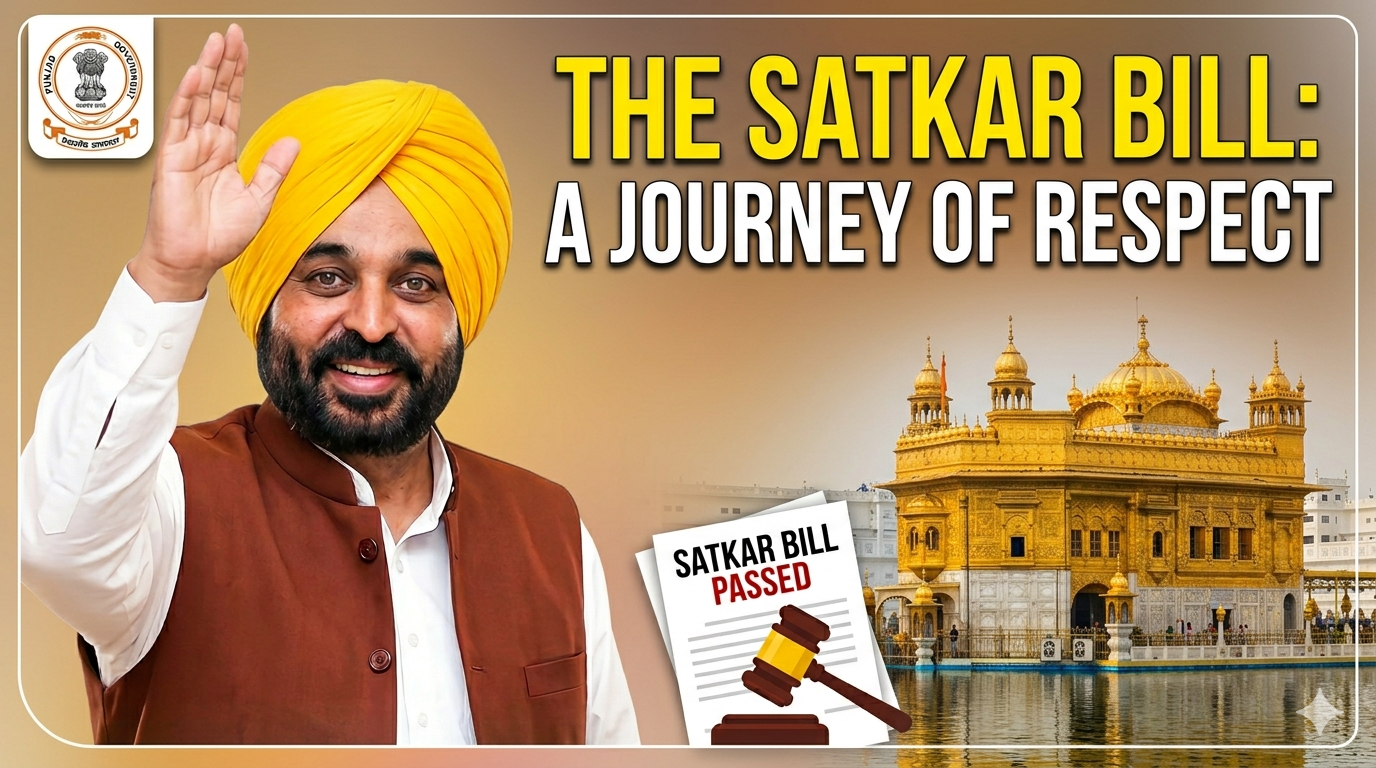
On April 13, 2026, coinciding with the occasion of Baisakhi, the Punjab Vidhan Sabha unanimously passed the Jaagat Jot Sri Guru Granth Sahib Satkar (Amendment) Bill, 2026. This legislation marks the toughest legal framework ever introduced in the state to prevent and punish acts of sacrilege (beadbi) involving the Guru Granth Sahib.
Unlike previous attempts in 2016 and 2018 that sought to amend the Indian Penal Code (IPC) and failed to get Presidential assent, this Bill amends a state-level 2008 Act, meaning it only requires the Governor's assent to become law.
Key Provisions and Penalties
The Bill introduces a tiered system of punishments based on the nature and intent of the crime:
|
Offence Category
|
Imprisonment Term
|
Fine Amount
|
|
Direct Act of Sacrilege
|
7 to 20 years
|
₹2 Lakh to ₹10 Lakh
|
|
Criminal Conspiracy (to disturb peace)
|
10 years to Life Imprisonment
|
₹5 Lakh to ₹25 Lakh
|
|
Abetment (helping/inciting)
|
Same as the direct offence
|
Same as the direct offence
|
|
Attempt to Commit Sacrilege
|
3 to 5 years
|
₹1 Lakh to ₹3 Lakh
|
|
Custodian Negligence
|
Up to 5 years
|
Up to ₹10 Lakh
|
Major Legal & Administrative Changes
1. Comprehensive Definition of Sacrilege
The Bill defines sacrilege as any willful and deliberate act of desecration, including:
-
Physical damage (burning, tearing, defacing, or theft) of the Saroop (physical copy) or any part of it.
-
Digital/Electronic Desecration: For the first time, the law specifically includes acts committed through electronic means or online content that hurts Sikh religious sentiments.
-
Insults through spoken or written words, signs, or visible representations.
2. Strict Investigation & Trial Protocols
-
Rank Requirement: Investigations must be conducted by an officer not below the rank of Deputy Superintendent of Police (DSP) or Assistant Commissioner of Police (ACP).
-
Non-Bailable: All offences under this Act are non-bailable, non-compoundable, and cognizable.
-
Fast-Track Trials: Cases will be tried specifically by Sessions Courts to ensure expedited justice.
3. Regulation of "Saroops"
-
Exclusive Printing Rights: Only the Shiromani Gurdwara Parbandhak Committee (SGPC) or entities authorized by it are permitted to print, publish, store, or distribute Saroops.
-
Unique Identification: The SGPC must maintain a central register (physical and digital) where every Saroop is assigned a unique ID number, tracking its printing, distribution, and current custodian.
-
Mandatory Reporting: Custodians are legally bound to report any loss or damage immediately and must follow the Sikh Rehat Maryada (Code of Conduct).
Political & Social Context
The Bill was tabled by Chief Minister Bhagwant Mann and seconded by Education Minister Harjot Singh Bains.
"This legislation will ensure that anyone found guilty of this unpardonable offence will not be spared. We have plugged all loopholes that previously allowed offenders to escape." — CM Bhagwant Mann
Why This Bill is Different
Previous governments (SAD-BJP in 2016 and Congress in 2018) saw their bills returned or stalled by the Central Government because they applied different punishments to different religions, which the Centre argued violated the principle of equality. By focusing specifically on the Guru Granth Sahib as a "Living Guru" under state law, the current administration aims to bypass those constitutional hurdles.
1 like |
0 comment