4.5/5
4.5/5




PMMSY Completes Six Years
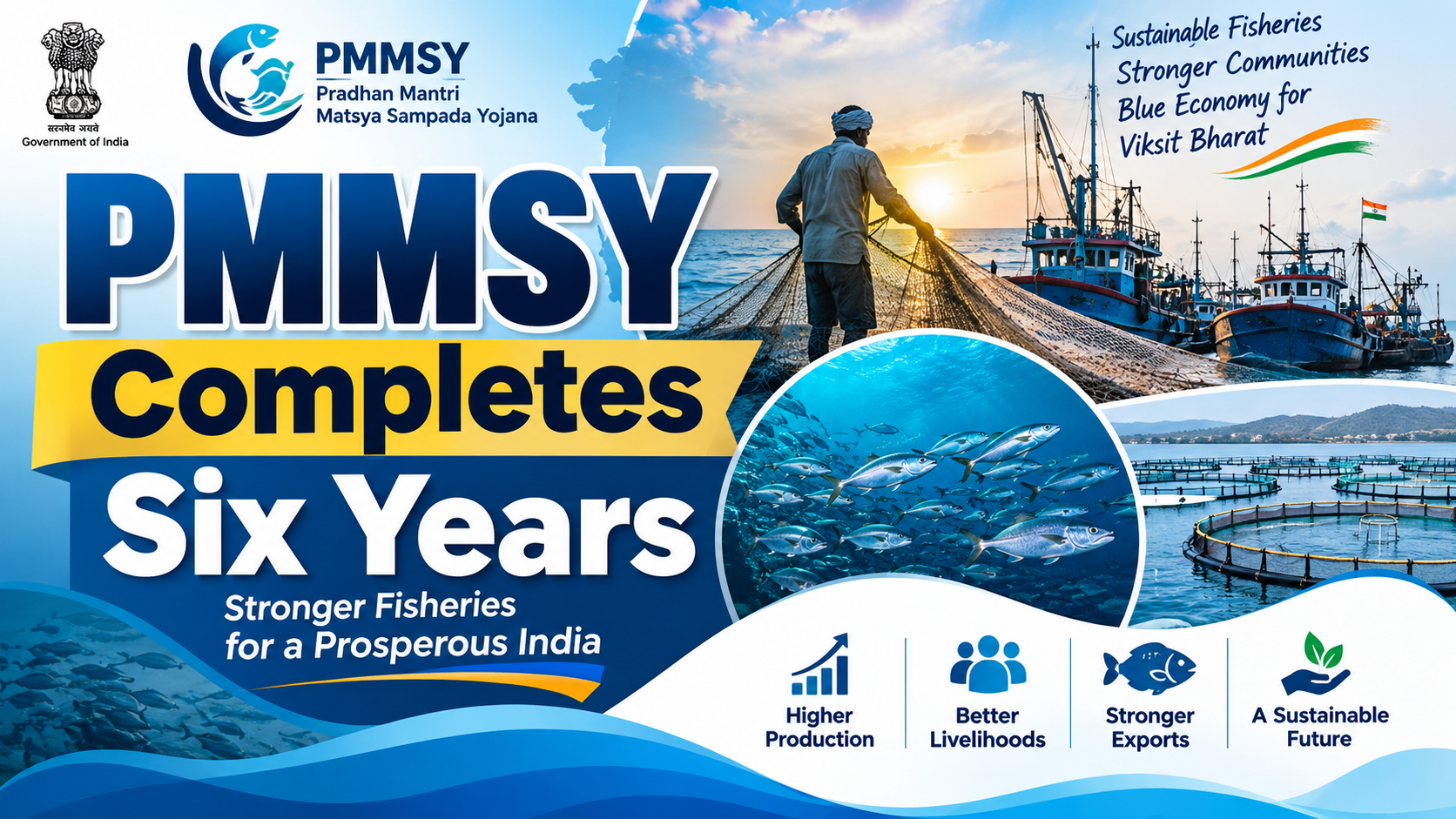
PMMSY Completes Six Years
Pradhan Mantri Matsya Sampada Yojana (PMMSY) –
-
Pradhan Mantri Matsya Sampada Yojana (PMMSY) was launched in 2020 to strengthen India’s fisheries sector.
-
PMMSY builds on the Blue Revolution, which was launched in 2015.
-
PMMSY has a total financial outlay of ₹20,750 crore.
-
A record ₹2,500 crore was allocated to PMMSY in BE 2026–27.
-
PMMSY is an umbrella scheme comprising a Central Sector Scheme (CS) and a Centrally Sponsored Scheme (CSS).
-
CSS Component: Includes beneficiary-oriented activities (₹12,340 crore) and non-beneficiary-oriented activities.
-
Central Sector Component: Provides support to Government and Government entities, with CG entities undertaking beneficiary-oriented activities.
-
The Pradhan Mantri Matsya Sampada Yojana (PMMSY) is implemented under the Ministry of Fisheries, Animal Husbandry and Dairying.
-
Fish production increased from 141.64 lakh tonnes in 2019–20 to a record 197.75 lakh tonnes in 2024–25.
-
Fisheries exports increased from ₹46,663 crore in 2019–20 to ₹73,890 crore in 2025–26.
-
PMMSY created employment opportunities for around 58 lakh persons in fisheries and aquaculture-related activities.
-
Fisheries and aquaculture projects worth ₹21,394.88 crore were approved during 2020–21 to 2025–26.
-
The approved projects included a Central share of ₹9,510.89 crore.
-
₹2,797 crore was approved for cold-chain and marketing infrastructure.
-
PMMSY approved 12 Integrated Aquaparks with a total investment of ₹713.80 crore.
-
Projects worth ₹198.17 crore were approved for seaweed cultivation and allied activities during 2020–25.
-
PMMSY supported 12,081 Recirculatory Aquaculture Systems (RAS).
-
PMMSY supported 4,205 Biofloc units to promote technology-driven aquaculture.
-
The scheme supported 2,672 ornamental fish rearing and integrated ornamental fish units.
-
Projects worth ₹544.86 crore were approved for 2,195 Fish Farmers Producer Organisations (FFPOs) during 2021–22 to 2025–26.
-
100 coastal fishermen villages have been identified as Climate Resilient Coastal Fishermen Villages (CRCFV).
-
Each identified CRCFV receives ₹200 lakh in government funding for resilient infrastructure, livelihoods and post-harvest facilities.
PM Matsya Sampada Yojana (PMMSY) – Targets
|
Particular
|
Details
|
|---|---|
|
Fish Production and Productivity
|
|
|
Fish Production
|
Increase from 13.75 million tonnes to 22 million tonnes by 2024–25
|
|
Aquaculture Productivity
|
Enhance from 3 to 5 tonnes per hectare
|
|
Domestic Consumption
|
Raise from 5 kg to 12 kg per capita
|
|
Economic Value Addition
|
|
|
Agriculture GVA Contribution
|
Increase from 7.28% to 9% by 2024–25
|
|
Export Earnings
|
Double from ₹46,589 crore to ₹1,00,000 crore by 2024–25
|
|
Private Investment
|
Boost entrepreneurship and private investment in fisheries
|
|
Post-Harvest Losses
|
Reduce from 20–25% to 10%
|
|
Income & Employment
|
|
|
Employment Opportunities
|
Create 55 lakh jobs across the fisheries value chain
|
|
Income Doubling
|
Double the incomes of fishers and fish farmers
|
PMMSY Scheme Eligibility Criteria
The PMMSY scheme is designed to benefit a wide range of participants in the fisheries sector. The PMMSY eligibility criteria are as follows:
-
Fishers and Fish Farmers: Individuals engaged in fishing and aquaculture activities.
-
Fisheries Cooperatives: Organizations involved in fisheries production and management.
-
Self-Help Groups (SHGs) and Joint Liability Groups (JLGs): Groups working in fisheries or aquaculture.
-
Entrepreneurs: Individuals or private firms engaged in fisheries-related businesses.
-
SC/ST/Women/Differently-abled Persons: Special provisions are made to include marginalized groups in the scheme.
Contribution to SDG 14: Life Below Water
PMMSY promotes sustainable and responsible fisheries and aquaculture, supporting the sustainable use and conservation of aquatic resources. It encourages modern and sustainable fish production methods such as Bio-floc, Recirculatory Aquaculture System (RAS), cage culture and mariculture, thereby contributing to SDG 14 – Life Below Water.
Blue Revolution
The Blue Revolution, launched in 2015, aims to increase fish production and strengthen the fisheries value chain across inland and marine sectors through improved productivity, infrastructure and modern practices. Building on these efforts, the Government launched Pradhan Mantri Matsya Sampada Yojana (PMMSY) in 2020 to promote post-harvest management, traceability, fisher welfare and market linkages.
Recirculatory Aquaculture System (RAS)
RAS is a modern fish-farming method in which water is filtered and reused. It removes waste and impurities, allowing the same water to be used repeatedly. It is suitable for high-density fish farming while requiring relatively less land and water.
Bio-floc Technology
Bio-floc technology uses beneficial microbes to convert organic waste into feed, thereby improving water quality and fish health. It is an eco-friendly and cost-effective method suitable for high-density fish farming and supports sustainable aquaculture practices.
0 like |
0 comment