4.5/5
4.5/5




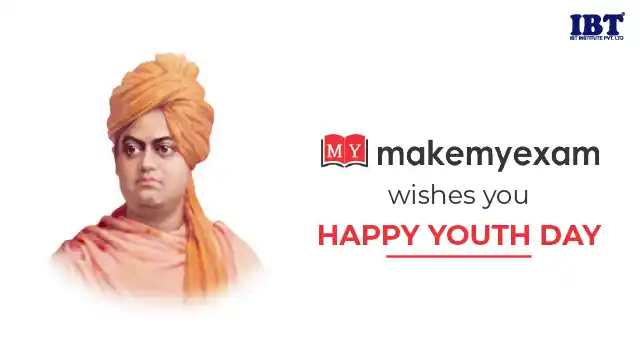
National Youth Day 2021: 12 January
National Youth Day: History
In 1984, the Indian Government first declared to celebrate the birthday of Swami Vivekananda i.e. 12 January as National Youth Day. Since then the day has been celebrated as National Youth Day all over the country. The main aim of the Government is to make a better future for the country by motivating the youths through the way of their life and ideas of the Swami Vivekananda. It is a great way to wake up the eternal energy of the youths as well as to make the country developed.
National Youth Day: Celebrations
National Youth Day or Yuva Diwas or the birthday of Swami Vivekananda is celebrated every year at many centres of Ramakrishna Math, Ramakrishna Mission, and their branches with great enthusiasm and joy according to the Indian culture and tradition. A great mangal aarti, devotional songs, meditation, religious speech, sandhya aarti, etc. are performed.
Also, at various schools, colleges it is celebrated by performing the parade, speech on Swami Vivekananda, recitations, songs, conventions, essay-writing competition, seminar, etc. To inspire the Indian youth's writings and lectures of Swami Vivekananda are also performed by the students. Several competitions are also performed not only in India but outside the country to promote education, trust among youths, etc. to make the country developed.
From 12th to 16th January National Youth Festival is celebrated every year. Along with the National Youth Festival, this year, the National Youth Parliament Festival is being organised. Due to COVID-19, the 24th edition of the National Youth Festival is being held in a virtual mode.
On 12th January 2021, the 24th National Youth Festival opening ceremony and the closing ceremony of the 2nd National Youth Parliament Festival both will take place in the Central Hall of Parliament.
The Theme of 2021 is "YUVAAH – Utsah Naye Bharat Ka"
About Swami Vivekananda
Swami Vivekananda's Pre-monastic name was Narendra Nath Dutta. He was born on 12 January, 1863 in Kolkata (previously Calcutta) and died on 4 July, 1902. His father's name was Vishwanath Dutta and his mother's name was Bhuvaneshwari Devi. He belonged to a well-off family. His father died suddenly at a young age and this broke the financial backbone of his family and was pushed into poverty. Despite being a good student, he failed to get a job for a very long time. He used to ask for a job from door to door but he didn’t get a job and so he became an atheist. One of his English professors introduced him with the name of 'Shri Ramkrishna Paramhamsa' and in 1881, he met with Shri Ramakrishna Paramhamsa at Dakshineshwar's Kali temple and became a disciple of Saint Ramakrishna Paramhamsa. He introduced Indian philosophies of Vedanta and Yoga to the Western World. He was extremely patriotic towards India and is considered a hero for his contributions to the philosophies of his country. He also drew attention to the wide-spread poverty in India and for the development of the country, the poverty issues should be taken seriously. He is best known for his speech at the Parliament of the World's Religions in Chicago in 1893 when he began his speech while saying "Sisters and brothers of America....." and he introduced India's culture, its importance, Hinduism, etc.
On 4 July 1902 (the day of his death), Vivekananda awoke early, went to the monastery at Belur Math and meditated for three hours. He taught Shukla-Yajur-Veda, Sanskrit grammar and the philosophy of yoga to pupils, later discussing with colleagues a planned Vedic college in the Ramakrishna Math. At 7:00 pm Vivekananda went to his room, asking not to be disturbed. he died at 9:20 p.m. while meditating. According to his disciples, Vivekananda attained mahasamādhi the rupture of a blood vessel in his brain was reported as a possible cause of death.