4.5/5
4.5/5




National Handloom Day : 7 August
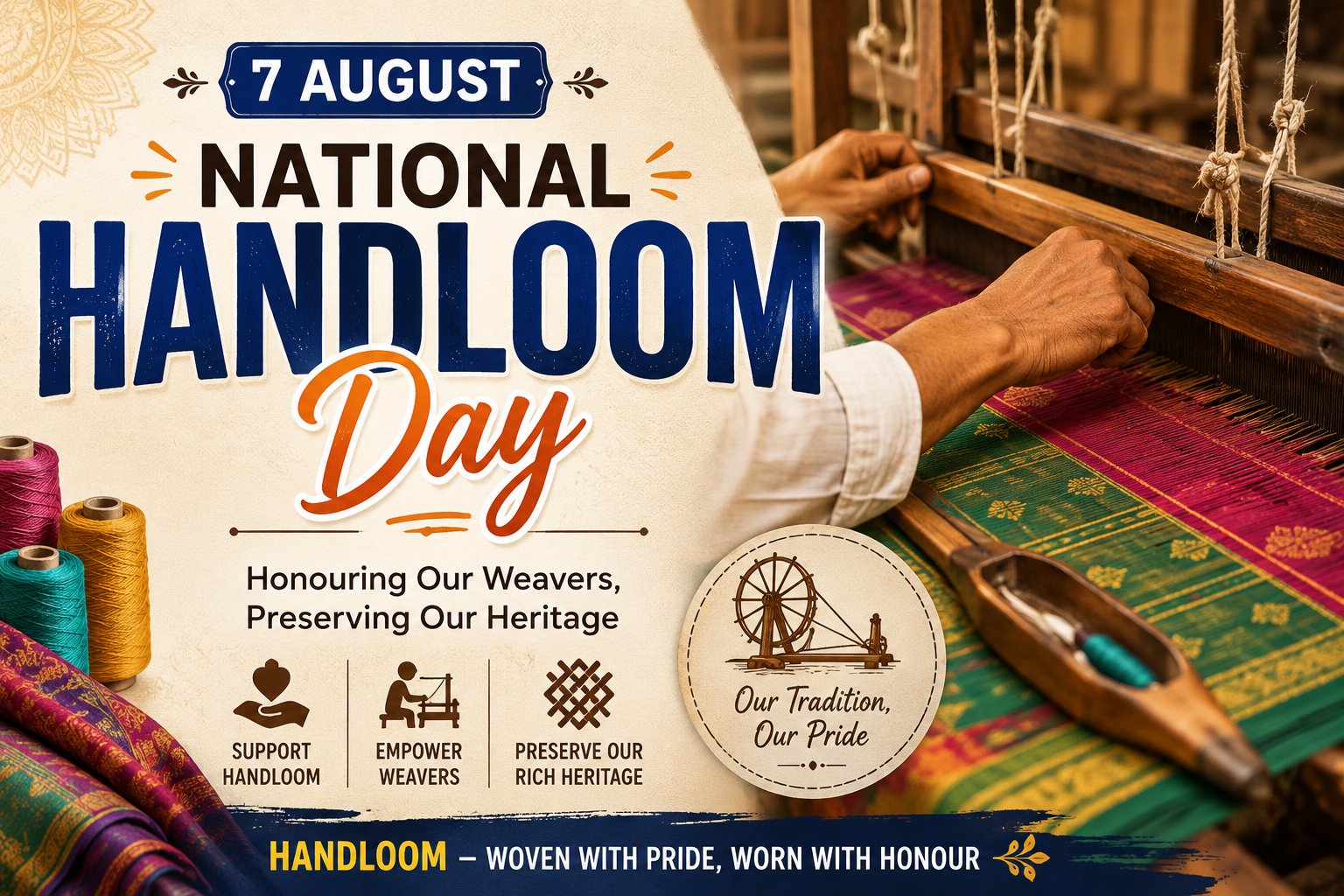
National Handloom Day : 7 August
- This day has been celebrated since 2015 and marks the launch of the Swadeshi Movement on 7th August 1905, part of the independence struggle promoting domestic handloom products.
- Handloom fabrics are generally made with high quality natural fibres like cotton, linen, silk, and wool which are resilient and last for a long time.
- Unique Handloom Products: Banarasi, Jamdani, Baluchari, Madhubani, Kosa, Ikkat, Patola, Tussar Silk, Maheshwari, Moirang Phee, Phulkari, Laheriya, Khandua and Tangaliya.
National Handloom Day 2026 History
- National Handloom Day commemorates the historic Swadeshi Movement and celebrates India’s rich handloom heritage by honouring the country’s weaving community.
- 7 August 1905: The Swadeshi Movement was launched at Calcutta Town Hall to boycott foreign goods and promote indigenous industries.
- Handloom weavers played a key role in the movement by producing and promoting Indian-made textiles.
- To commemorate this historic event, the Government of India declared 7 August as National Handloom Day.
- The first National Handloom Day was celebrated on 7 August 2015.
- The celebration was initiated by Prime Minister Narendra Modi to recognise the contribution of handloom weavers and artisans.
- Since 2015, the Ministry of Textiles has organised annual events, exhibitions, and awareness campaigns across the country.
- National Handloom Day 2026 marks the 12th edition of the annual celebration, continuing efforts to preserve traditional weaving techniques and promote Indian handloom products.
Famous Handloom Traditions of India
India is home to diverse handloom traditions, with each region producing unique handwoven textiles that reflect its history, culture, and exceptional craftsmanship.
India is home to diverse handloom traditions, with each region producing unique handwoven textiles that reflect its history, culture, and exceptional craftsmanship.
- Banarasi Silk (Uttar Pradesh): Famous for its luxurious silk fabric, intricate zari work, and exquisite bridal sarees.
- Kanchipuram Silk (Tamil Nadu): Renowned for rich silk, vibrant colours, and durable gold-thread borders used in traditional sarees.
- Jamdani (West Bengal): A fine muslin weave featuring delicate floral and geometric motifs crafted using the supplementary weft technique.
- Sambalpuri Ikat (Odisha): Known for its distinctive tie-and-dye weaving process and intricate traditional patterns.
- Pochampally Ikat (Telangana): Recognised for its geometric designs and colourful double ikat weaving technique.
- Paithani (Maharashtra): Celebrated for handwoven silk sarees adorned with peacock, lotus, and floral motifs using pure zari.
- Chanderi (Madhya Pradesh): Lightweight fabric admired for its sheer texture, elegant finish, and traditional motifs.
- Maheshwari (Madhya Pradesh): Popular for its reversible borders, fine cotton-silk blend, and classic striped or checked patterns.
- Muga Silk (Assam): Exclusive to Assam, this naturally golden silk is valued for its durability and natural sheen.
- Bhagalpuri Silk (Bihar): Also called Tussar Silk, it is prized for its natural texture, softness, and eco-friendly production.
- Kota Doria (Rajasthan): Lightweight cotton-silk fabric featuring the signature square-check pattern known as khat.
- Kasavu (Kerala): Traditional off-white sarees with elegant golden borders, commonly worn during festivals and cultural occasions.
Government Initiatives for the Handloom Sector
The Government of India has launched several initiatives to strengthen the handloom sector by improving weavers’ livelihoods, promoting traditional textiles, enhancing market access, and preserving India’s rich weaving heritage.
The Government of India has launched several initiatives to strengthen the handloom sector by improving weavers’ livelihoods, promoting traditional textiles, enhancing market access, and preserving India’s rich weaving heritage.
- National Handloom Development Programme (NHDP): Provides financial assistance for skill development, infrastructure, design innovation, and marketing support to handloom weavers.
- India Handloom Brand (IHB): Promotes high-quality, authentic handloom products that meet strict quality standards and helps increase consumer confidence.
- Yarn Supply Scheme (YSS): Ensures the timely availability of quality yarn at subsidised rates to reduce production costs for handloom weavers.
- Comprehensive Handloom Cluster Development Scheme (CHCDS): Develops major handloom clusters by improving common facilities, technology, and market connectivity.
- Raw Material Supply Scheme (RMSS): Facilitates easy access to quality raw materials, enabling artisans to maintain production and improve product quality.
- Handloom Marketing Assistance (HMA): Supports participation in national and international exhibitions, fairs, and buyer-seller meets to expand market opportunities.
- National Handloom Expo: Organises exhibitions across the country where artisans can directly sell their products and connect with consumers.
- Weaver MUDRA Scheme: Provides affordable credit and financial assistance to handloom weavers for expanding their businesses and purchasing equipment.
- Handloom Export Promotion: Encourages the export of Indian handloom products through trade fairs, branding, and international marketing initiatives.
0 like |
0 comment