4.5/5






National Education Day: 11 Nov 2026
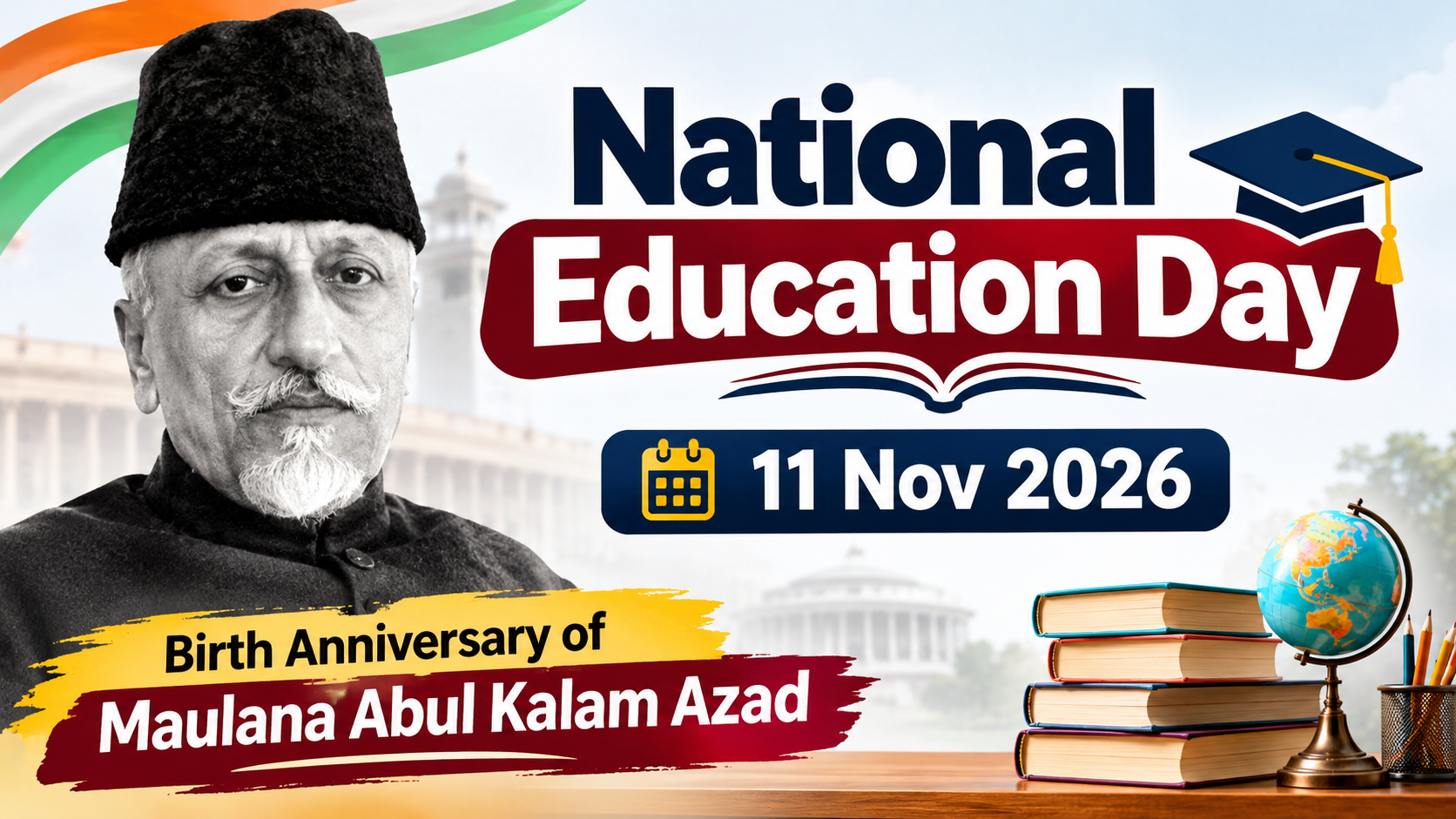
National Education Day: 11 Nov 2026
-
National Education Day is observed every year on 11 November in India to commemorate the birth anniversary of Maulana Abul Kalam Azad, the first Education Minister of independent India. It was first celebrated in 2008, and 2026 marks its 18th edition. The day highlights the importance of education and literacy in national development.
-
It is observed every year on 11th November to commemorate the birth anniversary of Maulana Abul Kalam Azad (1888–1958)
-
The observance was first announced in 2008 by the then Ministry of Human Resource Development (now the Ministry of Education).
Maulana Abul Kalam Azad:
-
He was born on 11th November 1888, in Mecca and later settled in Calcutta (Kolkata), where he emerged as a leading scholar and nationalist.
-
He served as India’s first Minister of Education (1947–1958) and introduced major reforms to strengthen scientific, technical, and cultural education.
-
He was instrumental in establishing the University Grants Commission (UGC), Indian Institutes of Technology (IITs), and Indian Institute of Science (IISc), as well as cultural bodies like the Sahitya Akademi, Lalit Kala Akademi, and Sangeet Natak Akademi.
-
In recognition of his immense contributions, he was posthumously awarded the Bharat Ratna in 1992.
-
Al-Hilal was an Urdu weekly newspaper established by Abul Kalam Azad in 1912 to propagate his radical anti-British views and forge Hindu-Muslim unity.
-
He was opposed to Jinnah’s two-nation theory.
-
He was the only person who remained president of the Indian National Congress for 6 years continuously before Independence of India.
-
He presided over the special session of Congress in September 1923 and at the age of 35 became the youngest man to be elected as the President of the Congress.
Education In India
Constitutional Provisions:
-
Part IV of Indian Constitution, Article 45 and Article 39 (f) of Directive Principles of State Policy (DPSP), has a provision for state-funded as well as equitable and accessible education.
-
The 42nd Amendment to the Constitution in 1976 moved education from the State to the Concurrent List.
-
The education policies by the Central government provides a broad direction and state governments are expected to follow it. However, it is not mandatory, for instance Tamil Nadu does not follow the three-language formula prescribed by the first education policy in 1968.
-
The 86th Amendment in 2002 made education an enforceable right under Article 21-A.
Related Laws:
-
Right To Education (RTE) Act, 2009 aims to provide primary education to all children aged 6 to 14 years and enforces education as a Fundamental Right.
2 likes |
0 comment