4.5/5






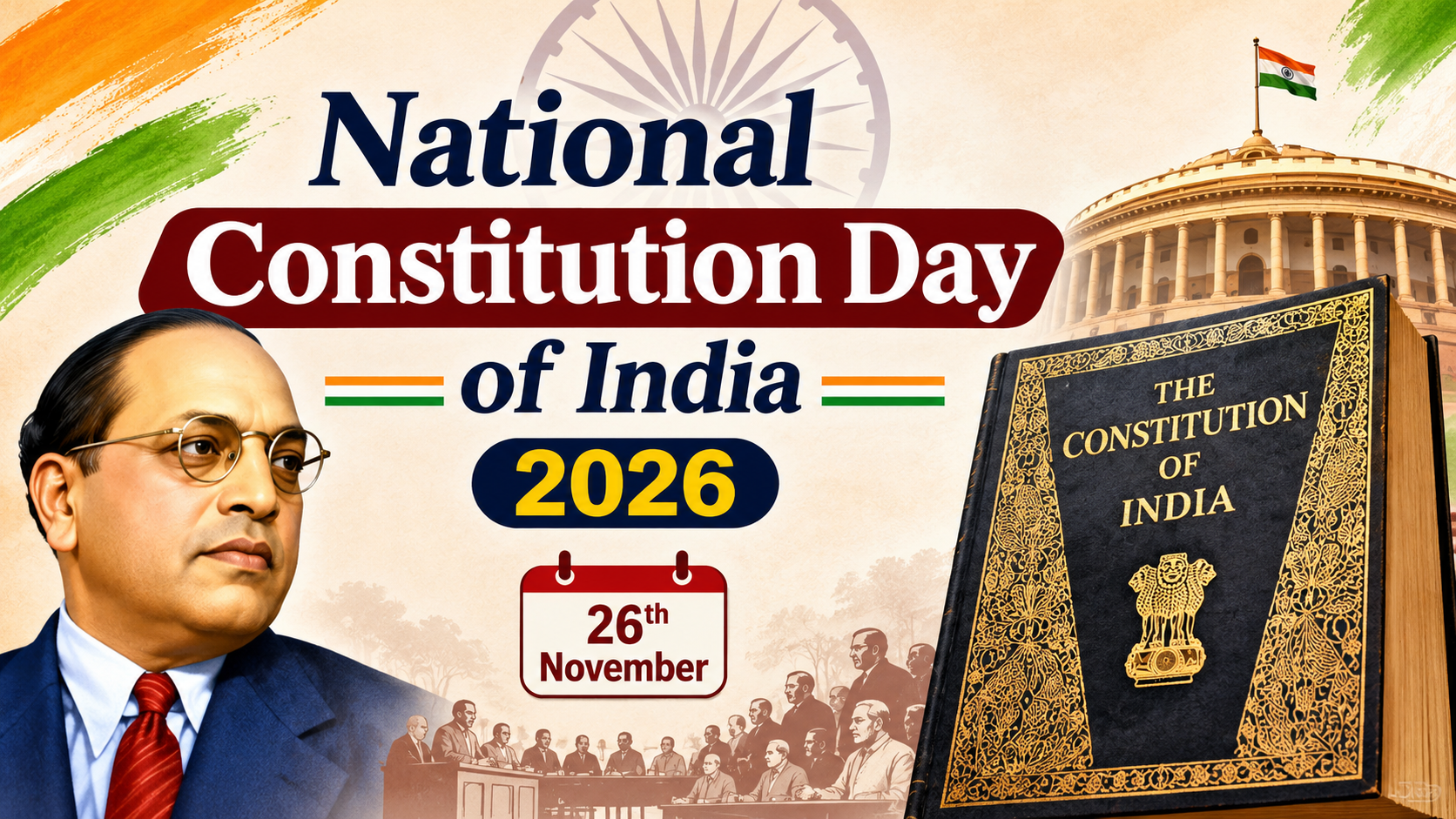
National Constitution Day of India 2026
National Constitution Day of India 2026
- Constitution Day is celebrated on 26th November every year.
-
It is also known as National Law Day or Samvidhan Diwas.
-
On this day in 1949, the Constituent Assembly of India formally adopted the Constitution of India, which came into force on 26th January 1950.
-
On 19th November 2015, the Ministry of Social Justice and Empowerment notified the decision of the Government of India to celebrate 26th November as Constitution Day.
Framing of Constitution:
-
In 1934, M. N. Roy first proposed the idea of a Constituent Assembly.
-
Under the Cabinet Mission Plan of 1946, the Constituent Assembly was formed.
-
The first meeting of the Constituent Assembly was held on 9th December 1946.
-
Dr. Sachchidananda Sinha was appointed as the temporary President of the Constituent Assembly.
-
Dr. Rajendra Prasad was elected as the permanent President on 11th December 1946.
-
B. N. Rau was appointed as the Constitutional Adviser.
-
The Constituent Assembly originally consisted of 389 members.
-
After the Partition of India, its strength was reduced to 299 members.
-
The Constituent Assembly appointed a total of 22 committees to deal with different tasks related to the framing of the Constitution.
-
There were 8 major committees, and the rest were minor committees.
-
The Drafting Committee was established on 29th August 1947, under the chairmanship of Dr. B. R. Ambedkar.
Major Committees and Their Chairmen:
-
Drafting Committee – Dr. B. R. Ambedkar
-
Union Powers Committee – Jawaharlal Nehru
-
Union Constitution Committee – Jawaharlal Nehru
-
Provincial Constitution Committee – Vallabhbhai Patel
-
Advisory Committee on Fundamental Rights, Minorities and Tribal and Excluded Areas – Vallabhbhai Patel
-
Rules of Procedure Committee – Dr. Rajendra Prasad
-
States Committee (Committee for Negotiating with States) – Jawaharlal Nehru
-
Steering Committee – Dr. Rajendra Prasad
Facts about the Constitution of India:
-
It is the lengthiest written Constitution of any sovereign country in the world.
-
India has a Federal System with Unitary Features.
-
India follows a Parliamentary Form of Government.
-
The framing of the Constitution took 2 years, 11 months and 18 days.
-
The original copies of the Indian Constitution were not typed or printed. They were handwritten and are preserved in special helium-filled cases in the Parliament Library.
-
Prem Behari Narain Raizada handwritten the original English copy of the Constitution.
-
The original Hindi version was handwritten by Vasant Krishan Vaidya.
-
The original Constitution was written in English and Hindi.
-
The original Constitution was decorated by Nandalal Bose and his team.
-
The Constitution of India was significantly influenced by the Government of India Act, 1935.
-
The Indian Constitution has borrowed several important features from the constitutions of different countries.
-
The Preamble declares India to be a Sovereign, Socialist, Secular, Democratic Republic.
-
The words Socialist, Secular and Integrity were added to the Preamble by the 42nd Constitutional Amendment Act, 1976.
Sources of the Indian Constitution:
-
Government of India Act, 1935 – Federal Scheme, Office of Governor, Judiciary, Public Service Commissions and Emergency Provisions.
-
British Constitution (UK) – Parliamentary Form of Government, Rule of Law, Single Citizenship, Cabinet System, Parliamentary Privileges and Legislative Procedure.
-
United States of America (USA) – Fundamental Rights, Independence of Judiciary, Judicial Review, Impeachment of President and Office of Vice-President.
-
Irish Constitution (Ireland) – Directive Principles of State Policy (DPSP), Nomination of Members to Rajya Sabha and Method of Election of President.
-
Canadian Constitution (Canada) – Federation with a Strong Centre, Residuary Powers with Centre and Advisory Jurisdiction of Supreme Court.
-
Australian Constitution (Australia) – Concurrent List, Freedom of Trade, Commerce and Intercourse and Joint Sitting of Two Houses of Parliament.
-
Weimar Constitution (Germany) – Suspension of Fundamental Rights during Emergency.
-
Soviet Constitution (USSR) – Fundamental Duties and Ideals of Social, Economic and Political Justice.
-
French Constitution (France) – Republic and Ideals of Liberty, Equality and Fraternity.
-
South African Constitution – Procedure for Amendment of the Constitution and Election of Members of Rajya Sabha.
-
Japanese Constitution (Japan) – Procedure Established by Law.
National Constitution Day of India – Drafting Timeline
|
Event
|
Date
|
|
Formation of Constituent Assembly
|
November–December 1946
|
|
First Meeting of the Constituent Assembly
|
9 December 1946
|
|
Dr. Rajendra Prasad Elected as President of the Assembly
|
11 December 1946
|
|
Formation of Drafting Committee under Dr. B. R. Ambedkar
|
29 August 1947
|
|
Presentation of Draft Constitution
|
4 November 1948
|
|
Adoption of Constitution by the Constituent Assembly
|
26 November 1949
|
|
Enforcement of Constitution / Republic Day
|
26 January 1950
|
1 like |
0 comment