4.5/5
4.5/5





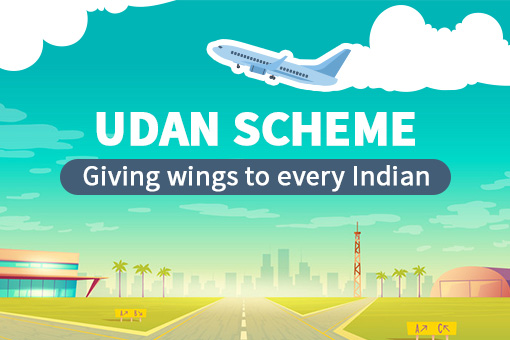
Modified UDAN Scheme
Modified UDAN Scheme
What is the Regional Connectivity Scheme – Modified UDAN?
-
About: The Modified UDAN scheme, introduced in the Union Budget 2025–26, is a revamped version of the UDAN (Ude Desh ka Aam Nagrik) initiative, aimed at ensuring affordable air travel, improving connectivity to Tier-2 and Tier-3 cities, and promoting both infrastructure development and long-term operational sustainability.
-
Need for the Modified UDAN: While the original UDAN scheme, launched in October 2016, successfully operationalized 663 routes and carried over 162.47 lakh passengers, it faced significant sustainability challenges:
-
High Discontinuation Rates: According to a Comptroller and Auditor General of India report, only 7% to 10% of routes remained financially viable after their initial subsidy period ended.
-
The original three-year cap on subsidies was not long enough for airlines to develop self-sustaining markets on Tier-2 and Tier-3 routes.
-
-
Abandoned Routes and Airports: Out of the 663 routes launched since 2017, 327 had fallen into disuse by February 2026.
-
Furthermore, 15 of the 95 airports revived under the scheme had ceased operations.
-
-
-
Core Pillars of the Modified UDAN:
-
Extended Subsidies (Viability Gap Funding): To keep airfares affordable (historically capped at Rs 2,500 per hour of flight for half the seats), the government subsidizes airline operators.
-
The modified scheme extends this subsidy window from three to five years, giving airlines a longer runway to establish profitable routes.
-
-
Direct Government Funding: Instead of funding these subsidies through an extra levy added to passenger tickets on major routes, the financial support will now come directly from the government exchequer.
-
Operations & Maintenance (O&M) Support: Moving beyond just building airports, the government will now actively subsidize the day-to-day running costs of low-traffic aerodromes to prevent them from shutting down.
-
Massive Infrastructure Expansion: The scheme targets the development of 100 airports from currently unserved airstrips and the construction of 200 modern helipads specifically designed for remote, hilly, and island regions.
-
Focus on Indigenous Aviation: Aligning with the Atmanirbhar Bharat initiative, the program includes provisions to procure locally manufactured aircraft, such as HAL Dhruv helicopters and HAL Dornier planes, to navigate difficult terrains.
-
What is the Background of UDAN Scheme?
-
About: UDAN is a flagship scheme of the Ministry of Civil Aviation aimed at democratising aviation and enhancing regional connectivity, ensuring access to air travel even in remote areas.
-
Launched under the National Civil Aviation Policy (NCAP) 2016, it focuses on connecting Tier-2 and Tier-3 cities through a market-driven yet financially supported model, with the Airports Authority of India (AAI) as the nodal implementing agency.
-
-
Core Mechanism & Funding: The scheme sustains affordable air travel through an airfare cap, financially supported by Viability Gap Funding (VGF) from the Centre.
-
This is backed by collaborative governance, including waived landing charges and state commitments to reduce VAT on Aviation Turbine Fuel (ATF) to 1% or less.
-
-
Massive Infrastructure Expansion: India’s overall airport network has more than doubled, growing from 74 airports in 2014 to 159 airports in 2024.
-
Strategic Evolution (UDAN 1.0 to 5.0): The initiative systematically expanded its scope from connecting underserved airports to including helipads in UDAN 2.0, introducing tourism routes in UDAN 3.0, focusing on hilly regions, the North-East, and island territories in UDAN 4.0, and further promoting seaplane operations under UDAN 5.0 series.
1 like |
0 comment