4.5/5
4.5/5





MGNREGA replaced by VB-G RAM G
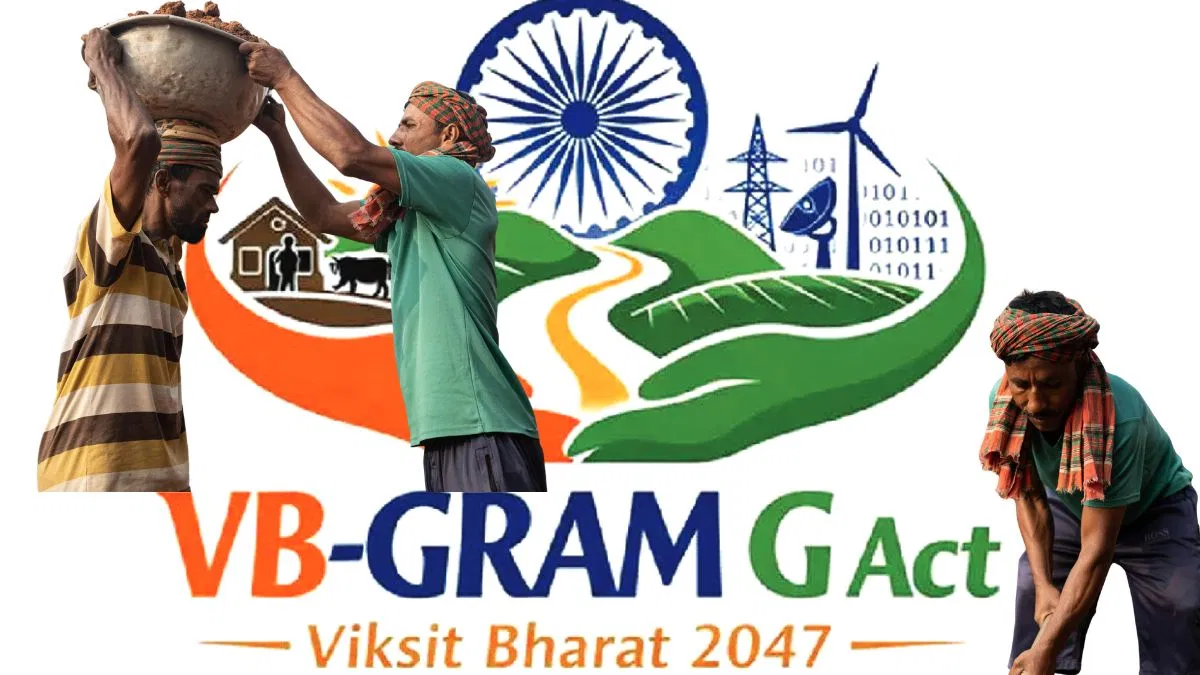
MGNREGA replaced by VB-G RAM G
The Act will come into force on 1 July, 2026 and the Mahatma Gandhi National Rural Employment Guarantee Act (MGNREGA), 2005 will stand repealed.
To ensure seamless transition, existing e-KYC verified MGNREGA Job Cards shall remain valid until Gramin Rozgar Guarantee Cards are issued.
Salient Features of the VB-G RAM G Ac
Salient Features of the VB-G RAM G Ac
- Viksit Bharat @2047 Alignment: Shifts towards integrated rural development and durable asset creation.
- Thematic Public Works: Prioritizes four areas- water security, core rural infrastructure, livelihood-related assets, and extreme weather mitigation.
Key Statutory Provisions - Centrally Sponsored Scheme: Shared responsibilities between Centre and States.
- Enhanced Guarantee: Mandates a statutory 125 days of guaranteed unskilled wage employment per rural household annually.
- Prompt Payments & Penalties: Wages must be paid weekly or within 15 days from closure of muster rolls; delays incur a daily compensation rate of 0.05% of unpaid wages.
- Unemployment Allowance: If employment not provided within 15 days, mandates an allowance at one-fourth of the notified wage for the first 30 days, and one-half thereafter.
- Agricultural Balance: Empowers States to notify up to a 60-day pause during peak sowing/harvesting seasons to secure farm labour.
- Tech-Enabled Governance: Integrates face authentication for attendance, GIS, AI-enabled analytics, real-time dashboards, and Direct Benefit Transfer (DBT).
- Participatory Planning: Execution relies on bottom-up Viksit Gram Panchayat Plans (VGPPs) seamlessly integrated into the Viksit Bharat-National Rural Infrastructure Stack (VB-NRIS).
What is VB-G RAM G?
- It is a legislative framework that repeals and replaces the MGNREGA, 2005, effective July 1, 2026. It transitions India’s rural safety net from an open-ended, demand-driven right to a centralized, supply-driven, budget-capped asset-creation mission.
Why Introduced?
- Rectifying Scattered Capital Spend: Sub-optimal asset creation under MGNREGA led to short-term distress employment rather than asset creation.
- Structural Labor Realignment: Nearly 45% of India’s rural workforce remains underemployed or engaged in low-productivity farm operations. (Source: Periodic Labour Force Survey). The framework systematically migrates excess labor into infrastructure assets.
- Capping Fiscal Volatility: Unpredictable mid-year supplementary budget spikes under demand-driven models created severe financial strains on the Union Treasury.
- Objectives
- Boost Rural Disposable Income: Elevate household consumption by expanding the baseline legal employment days.
- Build Durable Rural Assets: Align village level infrastructure to the PM Gati Shakti National Master Plan to accelerate saturation outcomes.
- Enforce Leakage-Free Governance: Deploy modern biometric, geospatial, and AI tools to eradicate corrupt intermediary networks.
- Key Features Of VB-G RAM G
- Enhanced Employment Threshold: Guarantees 125 days of wage employment per rural household annually, marking a 25% statutory increase over the older 100-day metric.
- Shared Financial Architecture: Operates as a Centrally Sponsored Scheme with a mandatory 60:40 Centre-to-State cost-sharing ratio for general states, and 90:10 for Himalayan and Northeastern states.
- Normative Budget Allocations: The Centre pre-defines and caps state budgets using objective indicators and rule-based parameters instead of open-ended demand requests.
- Statutory Agricultural Pause: Mandates a 60-day freeze on public works during peak local sowing and harvesting periods to preserve critical farm labor supply lines.
- Thematic Work Verticals: Restricts all public works strictly into four domains: water security, core rural infrastructure, livelihood-related assets, and climate resilience.
- Digital Surveillance Infrastructure: Deploys the Viksit Bharat National Rural Infrastructure Stack featuring mandatory face-authentication, real-time GPS tracking, and AI-enabled fraud monitoring.
Difference Between MGNREGA vs VB-G RAM G
|
|
|
|---|---|---|
|
|
|
|
|
|
|
|
|
|
|
|
|
|
|
|
|
|
|
|
|
|
|
|
0 like |
0 comment