4.5/5
4.5/5





Kargil Vijay Diwas 2026
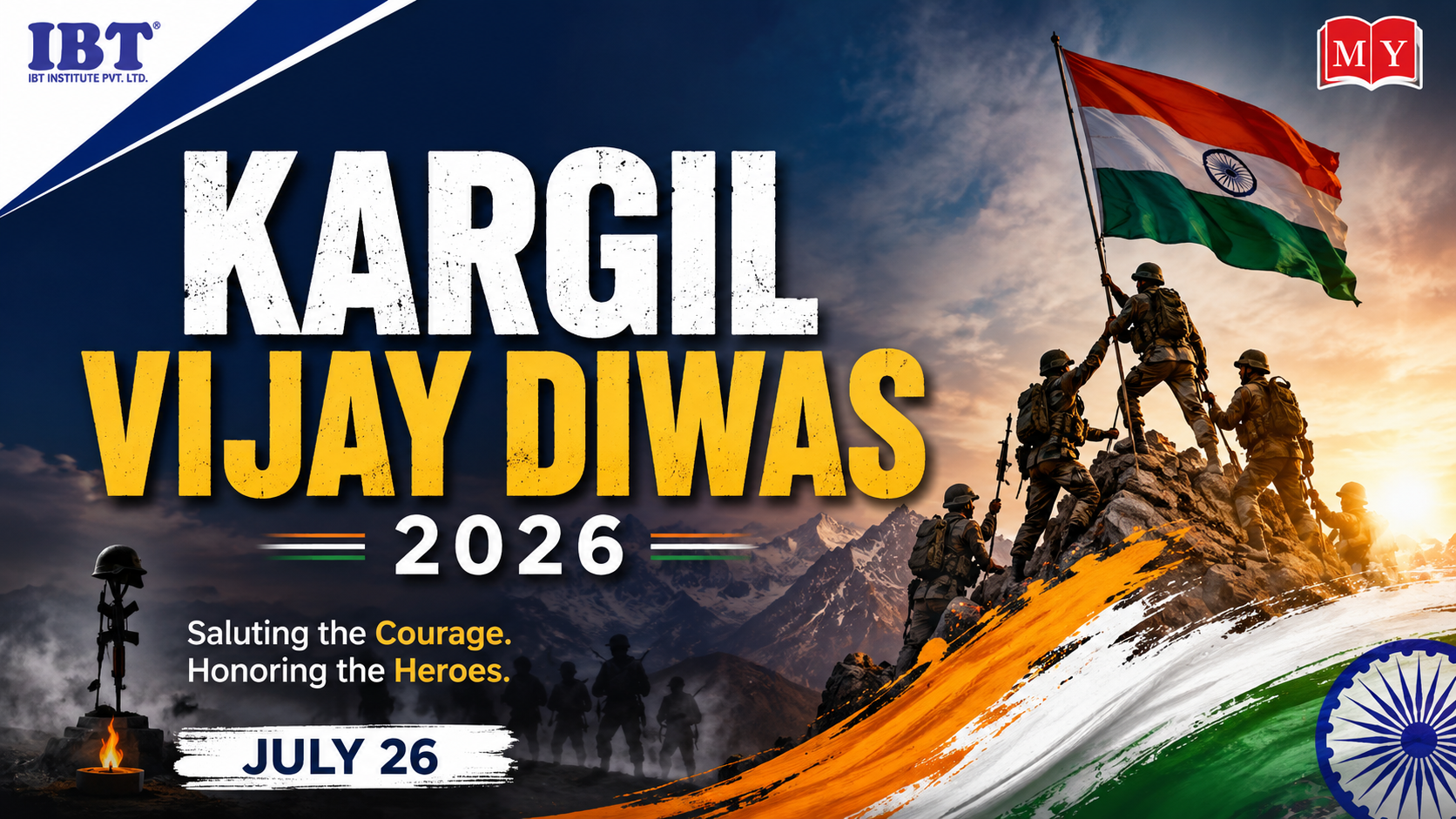
Kargil Vijay Diwas 2026
- Kargil Vijay Diwas 2026 is observed on 26 July 2026, commemorating the 27th anniversary of India’s victory in the Kargil War of 1999. The day pays tribute to the extraordinary courage, sacrifice, and patriotism of the Indian Armed Forces who reclaimed strategic positions occupied by Pakistani intruders along the Line of Control (LoC) in the Kargil sector.
- Kargil Vijay Diwas 2026 commemorates India’s successful military victory through Operation Vijay, which restored control over strategic positions in the Kargil sector. The Indian Army and the Government of India organize memorial ceremonies, outreach programmes, and public events to honor the martyrs and veterans. Kargil Vijay Diwas serves as a symbol of patriotism, national unity, and the unwavering commitment of the Indian Armed Forces to safeguarding the country’s sovereignty.
Kargil Vijay Diwas 2026 Theme
- Unlike many international observances, Kargil Vijay Diwas does not have an officially declared annual theme. The Kargil Vijay Diwas 2026 commemoration focuses on honoring the courage and sacrifice of the Kargil War heroes through nationwide memorial outreach programmes. It also aims to inspire patriotism, national unity, and awareness among the younger generation by sharing the stories of India’s brave soldiers.
Kargil Vijay Diwas 2026 Historical Background
- Kargil Vijay Diwas commemorates India’s victory in the Kargil War of 1999, fought to reclaim strategic positions occupied by Pakistani intruders along the Line of Control (LoC).
- The Kargil War was fought between India and Pakistan from May to July 1999.
- Pakistani soldiers and infiltrators crossed the Line of Control (LoC) and occupied strategic mountain peaks in the Kargil sector.
- The intrusion threatened National Highway 1A (now NH-1), India’s key supply route to Ladakh.
- India launched Operation Vijay to evict the intruders and restore control over the occupied areas.
- The Indian Air Force supported the mission through Operation Safed Sagar.
- Fierce battles were fought at Tiger Hill, Tololing, Point 4875, and other high-altitude locations.
- On 26 July 1999, India successfully regained the occupied territory and declared victory.
- Since 2000, Kargil Vijay Diwas has been observed every year on 26 July to honor the bravery and supreme sacrifice of the Indian Armed Forces.
Causes of the Kargil War
The Kargil War was triggered by strategic, political, and military factors that led to the infiltration of Pakistani forces across the Line of Control (LoC) in 1999.
Cross-border Infiltration: Pakistani soldiers and armed intruders secretly crossed the LoC and occupied strategic Indian positions in the Kargil sector.
-
Kashmir Dispute: The long-standing territorial dispute over Jammu and Kashmir remained the primary cause of tensions between India and Pakistan.
- Strategic Objective: Pakistan aimed to capture high-altitude peaks overlooking National Highway 1A (now NH-1) to disrupt India’s military supply route to Ladakh.
- Violation of the LoC: The infiltration violated the sanctity of the Line of Control and existing bilateral understandings.
- Military Miscalculation: Pakistan believed India would find it difficult to reclaim the occupied mountain positions due to the challenging terrain and weather.
- Failure of Diplomatic Efforts: The conflict occurred despite the Lahore Declaration (1999), which sought to improve relations between the two countries.
- Nuclear Tensions: The war took place shortly after both India and Pakistan conducted nuclear tests in 1998, raising concerns about escalation between two nuclear-armed neighbours.
Operation Vijay and India’s Military Response
Operation Vijay was the military operation launched by India in May 1999 to drive out Pakistani intruders from the Kargil sector and restore the sanctity of the Line of Control (LoC).
Operation Vijay was the military operation launched by India in May 1999 to drive out Pakistani intruders from the Kargil sector and restore the sanctity of the Line of Control (LoC).
- Launch of Operation Vijay: The Indian Army launched Operation Vijay on 26 May 1999 to recapture strategic peaks occupied by Pakistani forces and infiltrators.
- Objective: The mission aimed to evict the intruders, secure the Line of Control (LoC), and protect India’s territorial integrity.
- Operation Safed Sagar: The Indian Air Force supported ground operations through Operation Safed Sagar, providing aerial reconnaissance and precision strikes.
- High-Altitude Warfare: Indian soldiers fought at altitudes of 15,000-18,000 feet, facing steep terrain, freezing temperatures, and enemy fire.
- Major Battles: Fierce battles were fought at Tiger Hill, Tololing, Point 4875, Batalik, and Dras, leading to the recapture of key positions.
- Joint Military Effort: The Indian Army, Indian Air Force, and supporting logistics units worked in close coordination throughout the operation.
- Successful Outcome: By 26 July 1999, India had regained control of the occupied territories, forcing the withdrawal of Pakistani forces and declaring victory.
- Legacy: Operation Vijay is regarded as one of India’s most successful military campaigns and a symbol of the courage, determination, and sacrifice of the Indian Armed Forces.
0 like |
0 comment