4.5/5
4.5/5





India’s First National Household Travel Survey 2025–26
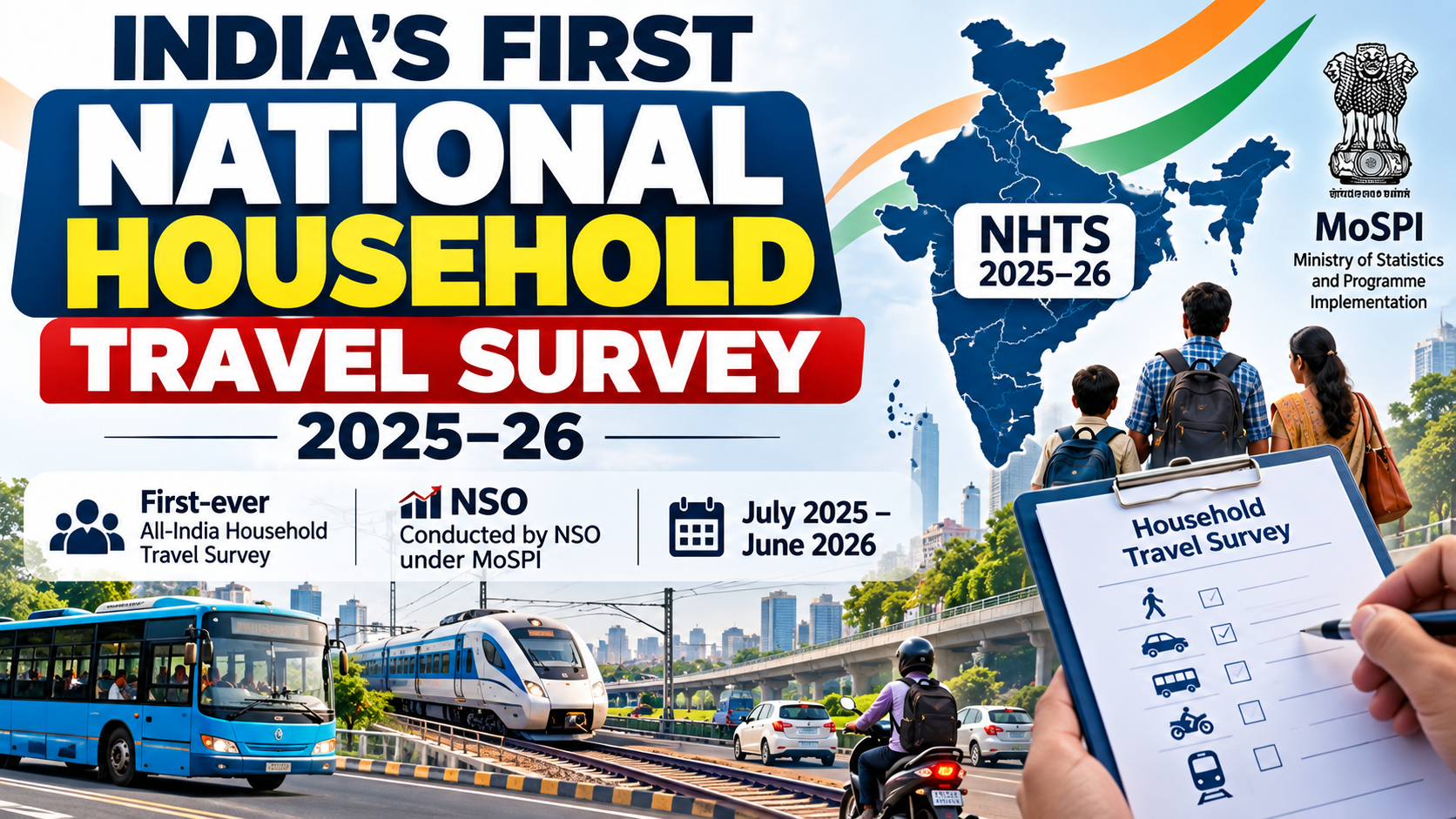
India’s First National Household Travel Survey 2025–26
‘Buses (55.8%) and Railways (17.7%) Account Most of Household Overnight Journeys’
‘Two-Wheelers Lead Workforce Mobility’
- The National Statistics Office (NSO) under the Ministry of Statistics and Programme Implementation (MoSPI) has released the key indicators and findings from the first ever National Household Travel Survey (NHTS), conducted during July, 2025 – June, 2026 through a Factsheet. For the purpose of the survey, a trip is defined as travel covering a distance of more than 1 km.
Primary objectives of the survey
The primary objective of the survey is to generate robust, data-driven insights into domestic travel patterns and dynamics to support regional transport planning, infrastructure development and evidence-based policy formulation. The survey captures key aspects of domestic travel, including:
- Purpose of travel: Employment, education, social engagements, cultural and leisure activities, tourism, domestic work, caregiving and other purposes.
- Mode of transport: Modes of transportation used by different demographic groups for undertaking trips.
- Travel duration and distance: Average time taken and distances travelled during trips.
Major Findings
The major findings of NHTS on four central aspects of commuting, namely, (i) mobility, (ii) duration & peak hours, (iii) expenditure involved, and (iv) overnight and non-work travel are summarised below:
Student Mobility
According to the survey, 66.4% of students aged 6 years and above travel at least 1 km to attend their educational institutions.
Student Mobility
According to the survey, 66.4% of students aged 6 years and above travel at least 1 km to attend their educational institutions.
Among students, the most common modes of transport are:
- Walking – 37.0%
- Bus – 29.5%
- Bicycle – 15.8%
- Auto-rickshaw – 10.5%
- Two-wheeler – 6.7%
Students aged 15–29 years recorded the highest regular trip participation at 77.0% nationally.
Two-Wheelers Lead Workforce Mobility
One of the most important findings is that two-wheelers are the most widely used mode of transport by workers, accounting for 42.6% of workplace travel.
Two-Wheelers Lead Workforce Mobility
One of the most important findings is that two-wheelers are the most widely used mode of transport by workers, accounting for 42.6% of workplace travel.
The share is:
- 37.1% in rural areas
- 52.3% in urban areas
- Overall, 57.6% of workers aged 15 years and above travel more than 1 km to reach fixed or non-fixed workplaces.
Travel Time to School and Work
The average travel time is:
The average travel time is:
- 23 minutes for students
- 25 minutes for workers travelling to a fixed workplace
- Around 87.6% of students reach their educational institutions within 30 minutes, while 83.4% of workers reach their fixed workplaces within 30 minutes.
Peak Travel Hours
The survey also identified major travel periods.
The survey also identified major travel periods.
For students:
- 82% depart between 7 AM and 10 AM
- Peak period: 8 AM to 9 AM
For workers:
- 94.9% leave before 10 AM
- Main peak period: 8 AM to 10 AM
Monthly Commuting Expenditure
The average monthly commuting expenditure is:
Students
- All India: ₹443
- Urban: ₹617
- Rural: ₹361
Workers
- All India: ₹785
- Urban: ₹1,044
- Rural: ₹612
- Male workers spend an average of ₹835 per month, compared with ₹533 for female workers.
Overnight Travel: Buses and Railways Dominate
- For household overnight travel, buses and railways together account for 73.5% of journeys.
The major modes are:
- Buses – 55.8%
- Inter-city railways – 17.7%
- Cars – 15.1%
- Two-wheelers – 8.8%
- Around 70.2% of overnight trips are undertaken for social, communication and religious purposes.
0 like |
0 comment