4.5/5
4.5/5




Independence Day 2026 :15 August
Independence Day 2026 :15 August
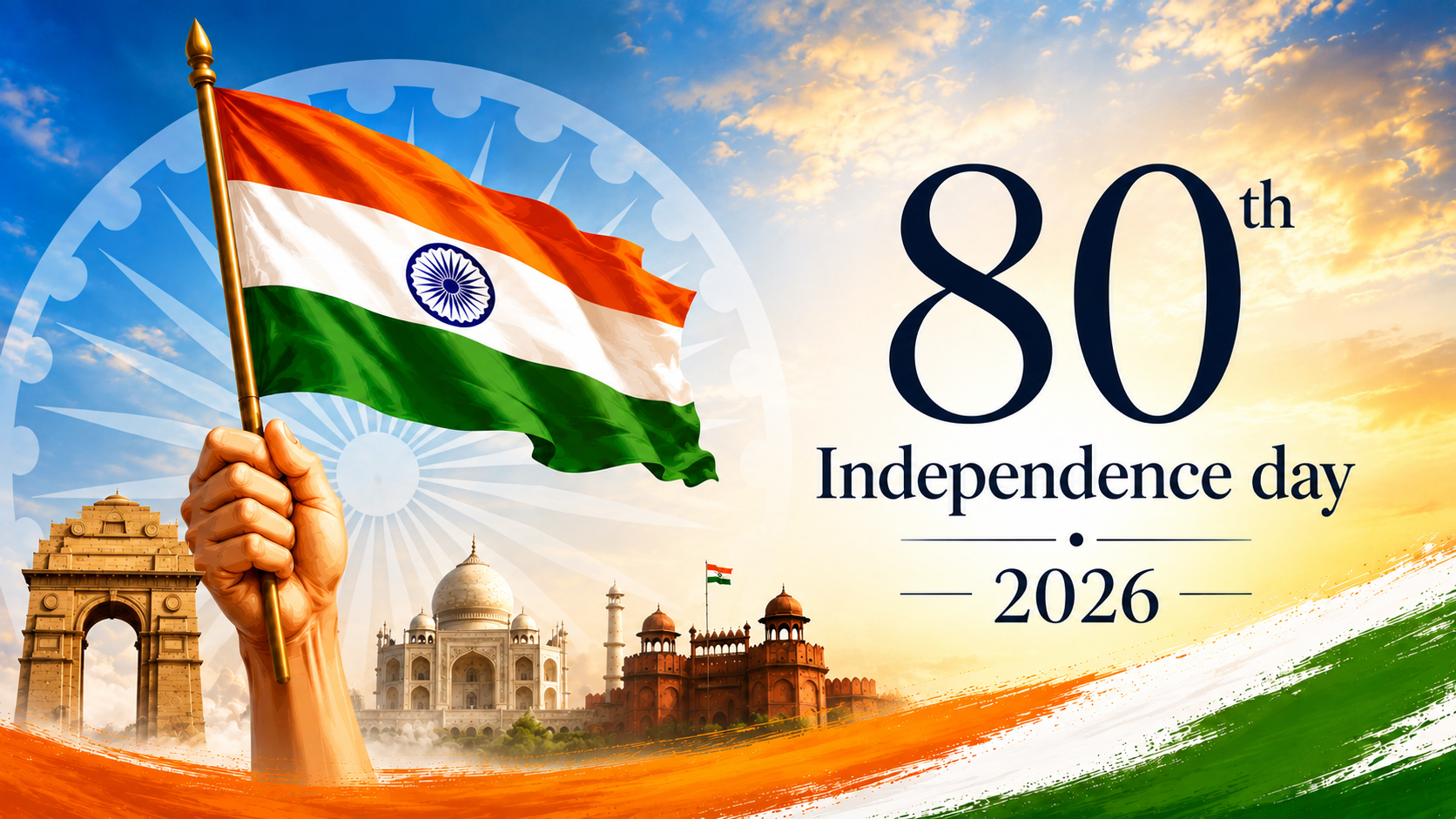
- Independence Day 2026 will be observed on 15 August 2026 as India’s 80th Independence Day. The occasion marks 79 years of India’s independence from British rule since 15 August 1947. The 2026 celebrations will combine historical remembrance with the vision of Viksit Bharat 2047. Major focus areas include indigenous technology, green transition, Atmanirbhar Defence, youth participation and the 150 year commemoration of Vande Mataram.
- India will celebrate 80th Independence Day 2026 on Saturday, 15 August. The national ceremony will be led by Prime Minister Narendra Modi at the Red Fort in New Delhi. The day will remember the freedom struggle and India’s democratic journey. It will also highlight youth, innovation, self reliance and sustainable development. The 80th Independence Day coincides with Navroz, the Parsi New Year, bringing additional cultural significance to the occasion.
Independence Day Theme 2026
The theme of Independence Day 2026 focuses on “150 Years of Vande Mataram” and “Yuva Shakti for Viksit Bharat@2047”. The themes connect India’s freedom movement with its future development goals. Vande Mataram represents the spirit of the national movement. Yuva Shakti highlights the role of young Indians in science, innovation, entrepreneurship and nation building. The celebrations also emphasise indigenous technologies, green transition and Atmanirbhar Defence.
Indian Independence Day 1947
The theme of Independence Day 2026 focuses on “150 Years of Vande Mataram” and “Yuva Shakti for Viksit Bharat@2047”. The themes connect India’s freedom movement with its future development goals. Vande Mataram represents the spirit of the national movement. Yuva Shakti highlights the role of young Indians in science, innovation, entrepreneurship and nation building. The celebrations also emphasise indigenous technologies, green transition and Atmanirbhar Defence.
Indian Independence Day 1947
- India became independent on 15 August 1947 after a prolonged freedom struggle against British colonial rule. The transfer of power followed the Indian Independence Act 1947 and the Mountbatten Plan.
- British political control expanded across India, beginning a long period of colonial rule that lasted nearly 200 years.
- The Revolt of 1857 became an early major armed challenge to British authority and an important milestone in India’s freedom struggle.
- The Indian National Congress was founded in 1885 and became a major platform for self government and independence.
- Leaders such as Bal Gangadhar Tilak, Mahatma Gandhi, Sarojini Naidu, Subhas Chandra Bose, Bhagat Singh, Jawaharlal Nehru and Sardar Vallabhbhai Patel strengthened the national movement.
- Mahatma Gandhi led major mass movements, including Non Cooperation, Civil Disobedience and Satyagraha, expanding public participation.
- In 1942, the Quit India Movement demanded an immediate end to British rule, with Gandhi giving the famous “Do or Die” call.
- On 20 February 1947, British Prime Minister Clement Attlee announced that power would be transferred to Indian hands by June 1948.
- Lord Mountbatten then proposed the 1947 Partition Plan, accepted by the Congress and Muslim League amid growing communal tensions.
- The Indian Independence Act 1947 was passed on 5 July and received Royal Assent on 18 July 1947.
- The Act created India and Pakistan as two independent dominions and ended British sovereignty.
- At midnight between 14 and 15 August 1947, power was transferred, making India independent on 15 August 1947.
- British paramountcy over princely states ended, while Constituent Assemblies received power to frame new constitutions.
- India’s First Independence Day 1947 was celebrated on 15 August 1947, marking the beginning of independent India.
Role of Freedom Fighters in India’s Independence
-
Uniting the Nation for a Common Goal: Freedom fighters brought people from different regions, religions, and backgrounds together with one shared aim, freedom from British rule. Their efforts helped create a strong sense of national unity and identity.
- Leading Non-Violent Movements: Leaders like Mahatma Gandhi inspired millions through peaceful protests and Civil Disobedience Movement, Non-Cooperation Movement, Dandi March, and Quit India Movement, proving that change could be achieved without violence.
- Organizing Mass Movements and Protests: Leaders like Sardar Vallabhbhai Patel led farmer-based movements such as the Kheda Satyagraha and Bardoli Satyagraha, helping people stand up against unfair taxes and British policies.
- Shaping Political Vision and Leadership: Jawaharlal Nehru played a key role in shaping India’s political direction and strongly advocated for complete independence (Purna Swaraj), motivating people to strive for full freedom.
- Taking Up Armed Resistance: Some revolutionaries chose a more direct approach. Subhas Chandra Bose formed the Indian National Army (INA) to fight British rule, while Bhagat Singh, Shivaram Rajguru, and Sukhdev sacrificed their lives to inspire courage and patriotism among the youth.
- Inspiring Youth and National Pride: Revolutionary leaders like Chandra Shekhar Azad and Bhagat Singh motivated young Indians to actively participate in the freedom struggle and stand against injustice.
- Promoting Social Reform and Inclusion: Leaders such as Sarojini Naidu encouraged women to take part in the freedom movement, while many others worked to reduce caste and religious divisions, promoting equality and unity.
- Spreading National Awareness: Leaders like Bal Gangadhar Tilak, Bipin Chandra Pal, and Lala Lajpat Rai spread awareness through movements like Swadeshi and public gatherings, encouraging people to boycott British goods and support Indian products.
- Strengthening Regional Movements: Freedom fighters like Chittaranjan Das led movements at the regional level, especially in Bengal, ensuring that the struggle for independence reached every corner of the country.
- Making Sacrifices for Freedom: Above all, freedom fighters made immense sacrifices, including imprisonment and even giving up their lives, to ensure that future generations could live in a free and independent India.
1 like |
0 comment