4.5/5
4.5/5





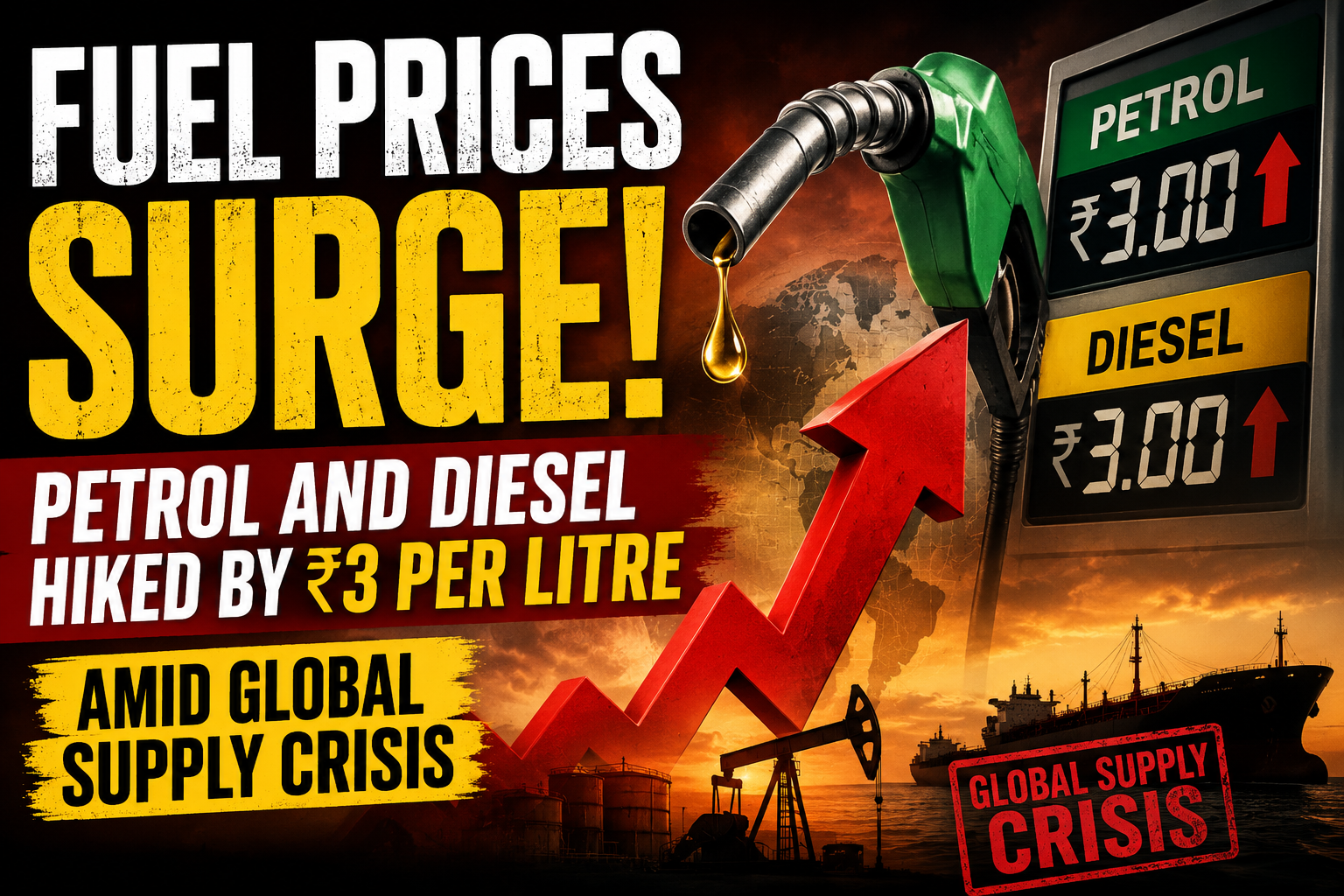
Fuel Prices Surge: Petrol and Diesel Hiked by ₹3 Per Litre Amid Global Supply Crisis
Fuel Prices Surge: Petrol and Diesel Hiked by ₹3 Per Litre Amid Global Supply Crisis
In a major development for the domestic energy market, state-run oil marketing companies (OMCs) have announced a nationwide increase in the prices of petrol and diesel by up to ₹3 per litre, effective immediately.
This decision ends an unprecedented four-year hiatus on daily price revisions, bringing a stark close to a prolonged period of retail price freeze that had shielded Indian consumers from turbulent international oil dynamics.
The New Retail Reality: Metro Breakdown
Because fuel rates are subjected to varying state-level value-added tax (VAT) structures, local levies, and freight charges, the final impact at the pump varies across major metropolitan hubs:
-
New Delhi: Petrol prices rose by ₹3.00, climbing from ₹94.77 to ₹97.77 per litre. Diesel saw an identical hike, rising from ₹87.67 to ₹90.67 per litre.
-
Mumbai: Perpetually maintaining some of the highest fuel rates among the metros, petrol surged by ₹3.14 to ₹106.68 per litre, while diesel ticked up to ₹93.14 per litre.
-
Kolkata: The eastern metropolis recorded the sharpest jump in the country. Petrol climbed by ₹3.29 to retail at ₹108.74 per litre, while diesel jumped by ₹3.11 to reach ₹95.13 per litre.
-
Chennai: In the south, petrol costs adjusted upwards by ₹2.83 to ₹103.67 per litre, and diesel increased by ₹2.86 to stand at ₹95.25 per litre.
Additionally, the ripples of the energy squeeze immediately spilled over into other transport fuels. Compressed Natural Gas (CNG) rates in the Delhi-National Capital Region (NCR) were promptly hiked by ₹2 per kg, setting a new price of ₹79.09 per kg.
The Catalyst: Geopolitical Escalation and a Choked Strait
- The sudden upward revision is directly tied to severe geopolitical friction in West Asia. Following the escalation of hostilities involving the US, Israel, and Iran that erupted on February 28, international energy benchmarks have traded at dangerously elevated levels.
- The conflict culminated in a blockade of the Strait of Hormuz—a critical maritime bottleneck through which roughly one-fifth of the world’s global petroleum consumption passes.
- The Cost of Volatility: India's imported crude oil basket, which comfortably averaged around $69 per barrel in February 2026 prior to the conflict, rapidly broke past the $100 threshold, hovering consistently between $113 and $114 per barrel in subsequent weeks.
Why the Freeze Broke: The Toll on Oil Retailers
- India’s state-run fuel retailers—IOC, BPCL, and HPCL—had frozen daily fuel price revisions since April 2022 after the Russia–Ukraine crisis, apart from a small ₹2 cut before the 2024 elections.
- Shielding consumers from rising costs became increasingly expensive, with OMCs reportedly losing around ₹1,000 crore daily and absorbing massive monthly losses.
- Petroleum Minister Hardeep Singh Puri said the current model had become unsustainable despite maintaining uninterrupted supply.
- Officials said today’s ₹3 hike is only a partial adjustment, covering just a fraction of the increase needed to match crude oil prices above $113 per barrel, while OMCs continue bearing most of the burden to avoid a major economic impact.
Economic Ripple Effects: Inflation and Transport Costs
- Coming on the heels of the conclusion of key assembly elections across Assam, Kerala, Tamil Nadu, and West Bengal, the price revision is anticipated to exert immediate inflationary pressure on the broader Indian economy.
- Data released just a day prior highlighted a massive spike in wholesale fuel inflation for April. Petrol inflation violently swung to 32.4% (up from 2.50% the previous month), while high-speed diesel inflation accelerated to 25.19% (up from 3.62%).
- The transport and logistics sectors are expected to feel the squeeze first. Commuters, transport unions, and freight operators have voiced severe concerns, as higher diesel costs fundamentally drive up the wholesale distribution costs of daily essentials, manufacturing raw materials, and agricultural goods.
1 like |
0 comment