4.5/5
4.5/5





Bhagat Singh Birth Anniversary 2026
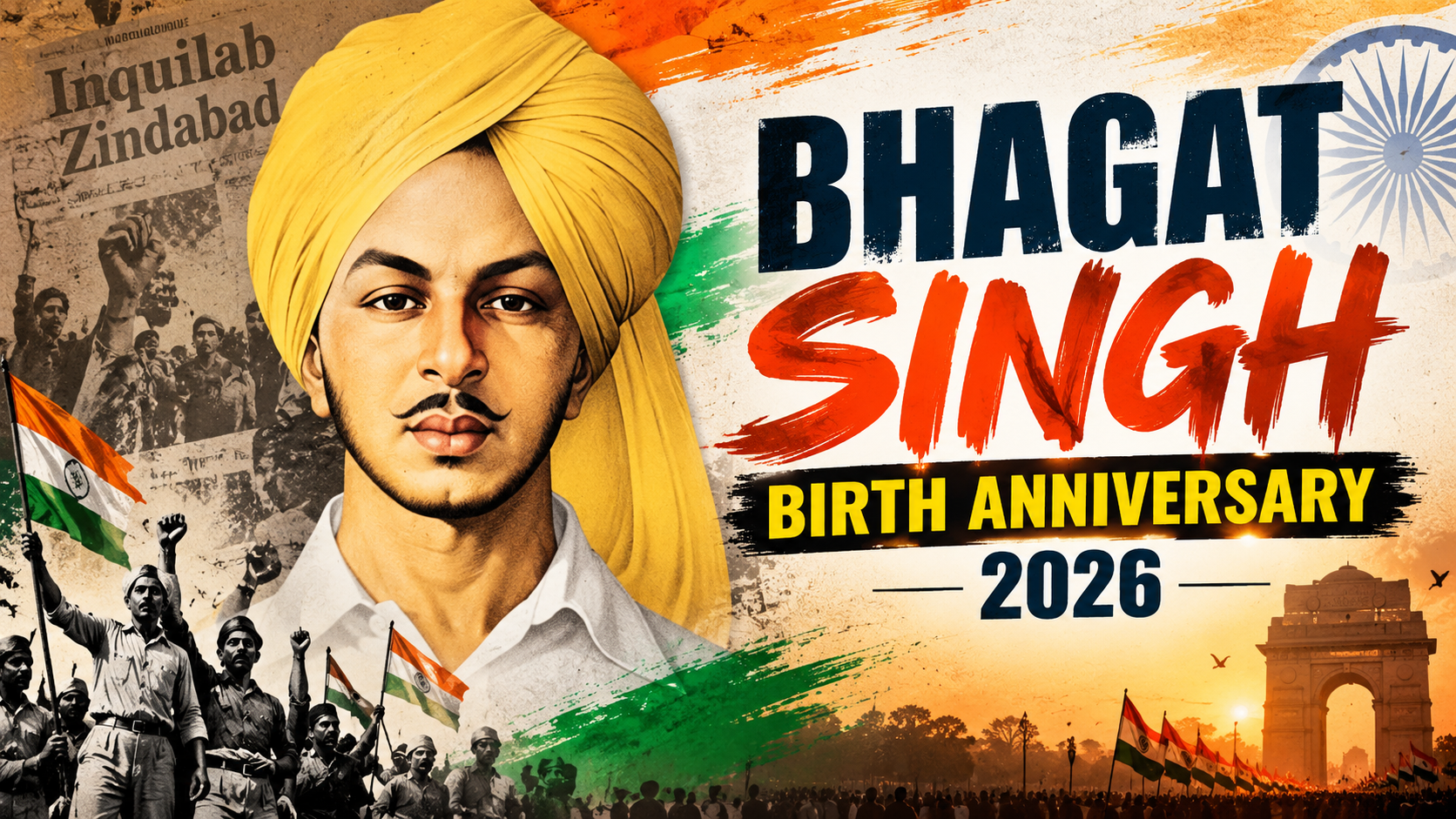
Bhagat Singh Birth Anniversary 2026
Bhagat Singh Birth Anniversary 2026 marks his 119th birth anniversary on 28 September, remembering his revolutionary role, sacrifice and contribution to India’s freedom struggle.
Bhagat Singh Biography
Bhagat Singh Birth Anniversary 2026 marks his 119th birth anniversary on 28 September, remembering his revolutionary role, sacrifice and contribution to India’s freedom struggle.
Bhagat Singh Biography
- Born: 28 September 1907
- Birthplace: Banga, Lyallpur district, Punjab Province, British India (now in Pakistan)
- Parents: Sardar Kishan Singh and Vidyavati
- Known For: Revolutionary activities against British rule
- Organisation: Hindustan Socialist Republican Association (HSRA)
- Major Associates: Chandrashekhar Azad, Sukhdev Thapar, Shivaram Rajguru, and Batukeshwar Dutt
- Major Activities: Central Legislative Assembly bombing (1929) and participation in revolutionary activities against British rule
- Political Ideas: Supported socialism, equality, secularism, and social justice
- Famous Slogan: “Inquilab Zindabad”
- Important Writing: “Why I Am an Atheist”
- Executed On: 23 March 1931
- Age at Execution: 23 years
- Legacy: Became a lasting symbol of courage, patriotism, sacrifice, and revolutionary nationalism in India.
Early Life and Education of Bhagat Singh
- Family Background: Belonged to a patriotic Sikh family involved in the freedom struggle.
- Father: His father, Kishan Singh, was associated with nationalist activities.
- Influence of Uncles: His uncles Ajit Singh and Swaran Singh also influenced his early nationalist thinking.
- Jallianwala Bagh: The Jallianwala Bagh massacre of 1919 deeply affected young Bhagat Singh.
- Early Schooling: Studied at Dayanand Anglo-Vedic School, Lahore.
- National College: Later joined National College, Lahore, founded by Lala Lajpat Rai.
- Academic Interests: Developed a strong interest in history, politics, economics, and revolutionary literature.
- Reading Habit: Read extensively about Indian nationalism, socialism, revolution, and international political movements.
- Political Awareness: His education and reading helped develop his ideas about freedom, social equality, and resistance to colonial rule.
Bhagat Singh’s Role in India’s Freedom Struggle
- Revolutionary Movement: Joined revolutionary organisations and worked with young nationalists to challenge British colonial rule.
- Hindustan Republican Association: Became associated with the Hindustan Republican Association (HRA) and later played an important role in its transformation into the Hindustan Socialist Republican Association (HSRA).
- Influence of Lala Lajpat Rai’s Death: After Lala Lajpat Rai died following injuries sustained during a police lathi charge while protesting the Simon Commission, Bhagat Singh and his associates sought to avenge his death.
- Saunders Assassination: In December 1928, Bhagat Singh and Shivaram Rajguru shot John Saunders, a British police officer in Lahore, in a case of mistaken identity.
- Central Legislative Assembly Bombing: On 8 April 1929, Bhagat Singh and Batukeshwar Dutt threw bombs in the Central Legislative Assembly in Delhi to protest against repressive colonial legislation.
- Purpose of the Bombing: The bombs were intended to make a political statement rather than cause mass casualties. Bhagat Singh and Dutt deliberately stayed at the scene and surrendered.
- Hunger Strike: During imprisonment, Bhagat Singh participated in a hunger strike demanding better treatment and equal facilities for Indian political prisoners.
- Use of the Courtroom: He and his fellow revolutionaries used their trial as a platform to communicate their political ideas and oppose British rule.
- Political Ideas: Bhagat Singh increasingly advocated socialism, equality, secularism, and freedom from economic exploitation.
- Inspiration for Youth: His courage, writings, and willingness to sacrifice his life made him a major inspiration for Indian youth during the freedom struggle.
- Supreme Sacrifice: Bhagat Singh was executed along with Sukhdev Thapar and Shivaram Rajguru on 23 March 1931 in Lahore Jail.
Key Points
Birth & Family
- Full Name: Shaheed Bhagat Singh
- Popular Title: Shaheed-e-Azam
- Date of Birth: 28 September 1907
- Place of Birth: Banga Village, Lyallpur District (now Faisalabad, Pakistan)
- He belonged to the Sandhu Jat Sikh family.
- Father: Sardar Kishan Singh
- Mother: Vidyawati Kaur
- Uncles: Ajit Singh and Swaran Singh
- Ajit Singh was associated with the Ghadar Movement (1913).
Education
- Bhagat Singh completed his higher education at National College, Lahore.
- The college was founded by Lala Lajpat Rai.
Early Inspirations
- Bhagat Singh was inspired by Kartar Singh Sarabha.
- He was also influenced by Madan Lal Dhingra.
Rowlatt Act & Jallianwala Bagh
- The Rowlatt Act was passed in 1919.
- It was based on the recommendations of the Sedition Committee.
- The committee was headed by Justice Sidney Rowlatt.
- The Jallianwala Bagh Massacre took place on 13 April 1919.
- Sir Michael O’Dwyer was the Lieutenant Governor of Punjab during the massacre.
- The firing was ordered by Brigadier General Reginald Dyer.
Revolutionary Organizations
- Bhagat Singh became a member of the Hindustan Republican Association (HRA).
- The HRA was founded by:
Ram Prasad Bismil
Sachindra Nath Sanyal
Jogesh Chandra Chatterjee
Activities in Lahore & Delhi
- Bhagat Singh returned to Lahore during the Jaito Morcha (1925).
- While staying in Delhi, he used the name Balwant Singh.
- He worked for the newspaper Vir Arjun.
Kirti Kisan Party
- Bhagat Singh joined the Kirti Kisan Party.
- The party was led by Sohan Singh Josh and Santokh Singh.
- He regularly contributed articles to the magazine Kirti.
Naujawan Bharat Sabha
- The Naujawan Bharat Sabha was founded in March 1926.
- Bhagat Singh served as its General Secretary.
Kakori Train Action
- The Kakori Train Action took place on 9 August 1925.
- It was carried out by members of the Hindustan Republican Association (HRA).
- After the Kakori Case, the HRA was reorganized.
Formation of HSRA
- In September 1928, the HRA was reorganized as the Hindustan Socialist Republican Association (HSRA).
- The reorganization took place at Feroz Shah Kotla, Delhi.
- Chandra Shekhar Azad became the Commander-in-Chief of the HSRA.
Simon Commission & Saunders Case
- The Simon Commission arrived in India in 1928.
- Lala Lajpat Rai was injured during the protest at Lahore on 30 October 1928.
- He died on 17 November 1928.
- Bhagat Singh decided to avenge his death.
- The actual target was James A. Scott.
- J.P. Saunders was mistakenly shot on 17 December 1928.
- This incident became famous as the Lahore Conspiracy Case.
Central Legislative Assembly Bombing
- On 8 April 1929, Bhagat Singh and Batukeshwar Dutt threw bombs in the Central Legislative Assembly, Delhi.
- The bombs were intentionally non-lethal.
- They protested against the:
- Public Safety Bill
- Trade Disputes Bill
- They shouted the slogan “Inquilab Zindabad” inside the Assembly.
Imprisonment & Hunger Strike
- Bhagat Singh was lodged in Mianwali Central Jail.
- He demanded equal treatment for Indian political prisoners.
- Revolutionary Jatin Das joined the hunger strike.
- Jatin Das died after 63 days of fasting on 13 September 1929.
Martyrdom
- Bhagat Singh, Rajguru, and Sukhdev were executed on 23 March 1931.
- They were hanged at Lahore Central Jail.
- Their bodies were secretly taken to Hussainiwala (Ferozepur) on the banks of the Sutlej River.
Memorial
- The National Martyrs Memorial is located at Hussainiwala, Punjab.
- It commemorates the sacrifice of Bhagat Singh, Rajguru, and Sukhdev.
Famous Names, Slogans & Writings
- Popularly known as Shaheed-e-Azam.
- Famous slogan: “Inquilab Zindabad.”
- Famous essay: “Why I Am an Atheist.”
Ideology
- Bhagat Singh believed in Revolutionary Socialism.
- He was influenced by the ideas of:
-
Karl Marx
-
Friedrich Engels
-
Vladimir Lenin
-
Mikhail Bakunin
-
Important Slogans / Quotes
- “Inquilab Zindabad” → Coined by Maulana Hasrat Mohani and popularised by Bhagat Singh.
0 like |
0 comment