4.5/5
4.5/5





Anti Paper Leak Bill 2026
Anti Paper Leak Bill 2026
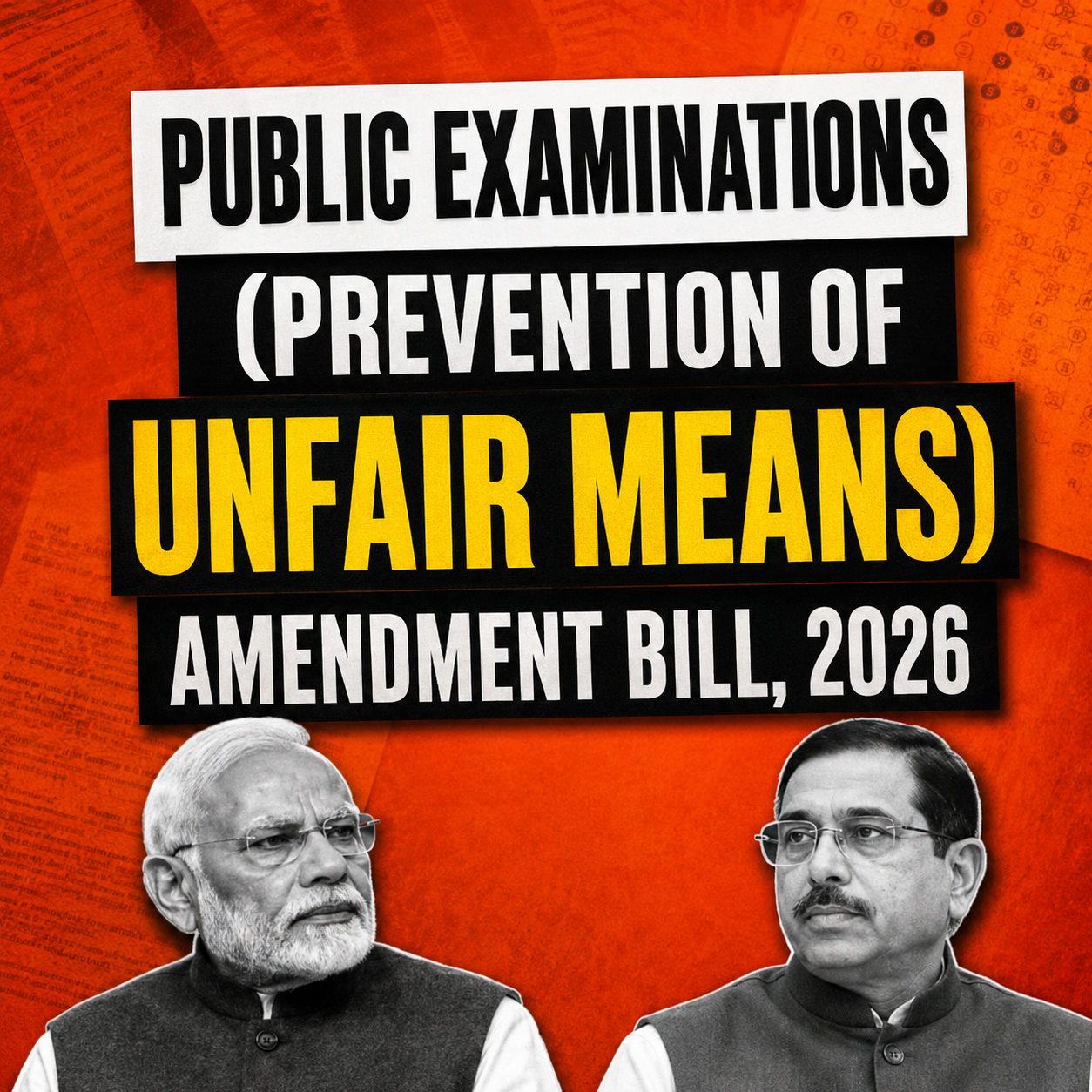
- The Public Examinations (Prevention of Unfair Means) Amendment Bill, 2026, commonly referred to as the Anti Paper Leak Bill 2026, is an amendment to the Public Examinations (Prevention of Unfair Means) Act, 2024. This Bill tries to strengthen the Indian legal mechanism against examination fraud by imposing stringent punishment, increasing financial penalty, time-bound investigation, establishing Special Fast Track Courts, and increased accountability on institutions or service providers responsible for any kind of paper leak.
- After receiving the approval of the Union Cabinet on 24 July 2026, this bill was introduced in the Lok Sabha on 27 July 2026 in the Monsoon Session of the Parliament by the Union Minister, Dr. Jitendra Singh. The proposed amendments include imprisonment up to 10 years, penalty of up to ₹10 crore, completion of the investigation process within 60 days, and speedy disposal of the case through Special Fast Track Courts.
- This Bill intends to establish faith in the Indian public examination process by safeguarding the interest of honest candidates who appear for examinations like NEET, JEE Main,CUET,UGC NET,SSC,UPSC,RRB, and IBPS. , and other examinations which have been notified by the Central Government.
Latest Updates on Anti Paper Leak Bill 2026
The Anti Paper Leak Bill, 2026 has made considerable progress in the Monsoon Session of Parliament.
- The Bill was passed by the Union Cabinet on 24th July 2026.
- The Bill was presented in the Lok Sabha on 27th July 2026.
- Union Minister Dr. Jitendra Singh presented the Bill.
- The proposed changes provide imprisonment up to 10 years.
- The penalty could go up to Rs. 10 crore.
- The investigation must be concluded in 60 days.
- The trials will be conducted in Special Fast Track Courts daily.
- The trials must be completed within three months of filing the chargesheet.
- Special Public Prosecutors will be appointed by States for the fast prosecution.
What is the Anti Paper Leak Bill 2026?
The Anti Paper Leak Bill 2026 seeks to amend the Public Examinations (Prevention of Unfair Means) Act 2024 to ensure that severe sanctions are meted out to all individuals, syndicates, bodies, and service providers engaged in the practice of examination malpractice.
The Anti Paper Leak Bill 2026 seeks to amend the Public Examinations (Prevention of Unfair Means) Act 2024 to ensure that severe sanctions are meted out to all individuals, syndicates, bodies, and service providers engaged in the practice of examination malpractice.
These include the following organised unfair means such as:
- Leakage of question papers
- Distributing answers prior to the examinations
- Hacking into the examination database
- Manipulation of OMR sheets
- Impersonation in examinations
- Phantom examination centres
- Manipulation of examination documentation
- Cheat networks
- Unlike normal examination malpractice, the Anti Paper Leak Bill 2026 aims to address the issue of organised crime activities that undermine the fairness of national level examinations.
Expert Insight: The most important feature about this law is that it no longer punishes individual examination candidates but aims to shut down organised paper leak networks that conduct examination malpractices.
Why Was the Anti Paper Leak Bill 2026 Introduced?
The Bill came into effect after some very well-publicized instances of cheating occurred in examination processes conducted for recruitment purposes in many examinations all over the country. In the last few years, there have been several instances where the paper leak has occurred, resulting in:
The Bill came into effect after some very well-publicized instances of cheating occurred in examination processes conducted for recruitment purposes in many examinations all over the country. In the last few years, there have been several instances where the paper leak has occurred, resulting in:
- Paper leaks leading to cancellation of examinations
- Delay in admissions and recruitment
- Financial burden due to re-examinations
- Loss of trust in competitive examinations
One of the important events triggering such stringent action was the NEET-UG examination where people talked about the examination security in the entire nation. Some students organizations were demanding stringent laws to make sure the culprit is punished for their actions.
|
Timeline of the Anti Paper Leak Bill
|
|
|
Date
|
Development
|
|
February 2024
|
Public Examinations (Prevention of Unfair Means) Bill introduced in Parliament
|
|
June 2024
|
Public Examinations (Prevention of Unfair Means) Act, 2024 came into force
|
|
2024–2026
|
Multiple incidents of examination fraud and paper leak investigations highlighted the need for stronger legal provisions
|
|
24 July 2026
|
Union Cabinet approved the Public Examinations (Prevention of Unfair Means) Amendment Bill, 2026
|
|
27 July 2026
|
Bill introduced in the Lok Sabha by Union Minister Dr. Jitendra Singh
|
|
Current Stage
|
Under Parliamentary consideration
|
|
Final Stage
|
Passage by both Houses followed by Presidential assent
|
Important: The Bill has been introduced in Parliament but is not yet a law. It will become enforceable only after completing the legislative process.
Dr. K. Radhakrishnan Committee (2024)
The Ministry of Education constituted the 7-member High-Level Committee of Experts (HLCE) in June 2024, chaired by former ISRO Chairman Dr. K. Radhakrishnan, following the UGC-NET paper leak and allegations of irregularities in NEET-UG 2024.
Mandate: To recommend reforms in the National Testing Agency (NTA), strengthen examination security and data protection, review the NTA's structure and SOPs, and ensure the transparent, fair, and secure conduct of public examinations.
The committee submitted its report, "The Reformation of National Common Entrance Testing in India," containing 101 recommendations across examination reforms, institutional restructuring, technology, and data security.
Key Recommendations: Strengthen the NTA with permanent domain experts, establish specialized verticals, prefer government examination centres, create State and District-Level Coordination Committees, introduce DIGI-EXAM with Aadhaar-based biometric authentication, encrypted question paper transmission, enhanced CCTV surveillance, AI-based monitoring, and a phased transition to computer-based and adaptive testing.
Implementation: By 2026, a majority of the recommendations had been implemented or were under active execution, including Aadhaar-based biometric verification, mobile jammers, expanded CCTV coverage, and increased use of government examination centres.
The Ministry of Education constituted the 7-member High-Level Committee of Experts (HLCE) in June 2024, chaired by former ISRO Chairman Dr. K. Radhakrishnan, following the UGC-NET paper leak and allegations of irregularities in NEET-UG 2024.
Mandate: To recommend reforms in the National Testing Agency (NTA), strengthen examination security and data protection, review the NTA's structure and SOPs, and ensure the transparent, fair, and secure conduct of public examinations.
The committee submitted its report, "The Reformation of National Common Entrance Testing in India," containing 101 recommendations across examination reforms, institutional restructuring, technology, and data security.
Key Recommendations: Strengthen the NTA with permanent domain experts, establish specialized verticals, prefer government examination centres, create State and District-Level Coordination Committees, introduce DIGI-EXAM with Aadhaar-based biometric authentication, encrypted question paper transmission, enhanced CCTV surveillance, AI-based monitoring, and a phased transition to computer-based and adaptive testing.
Implementation: By 2026, a majority of the recommendations had been implemented or were under active execution, including Aadhaar-based biometric verification, mobile jammers, expanded CCTV coverage, and increased use of government examination centres.
K Radhakrishnan Committee Latest News (2026) :
-
The report has gained renewed attention after the 2026 NEET paper leak controversy.
-
The Supreme Court is hearing petitions seeking reforms in NEET examination conduct.
-
The Central Government informed the Supreme Court that a high-powered committee headed by Nandan Nilekani has been constituted to recommend the next phase of examination reforms.
-
The government has introduced the Public Examinations (Prevention of Unfair Means) Amendment Bill, 2026 in the Lok Sabha to strengthen anti-paper leak laws.
-
The K. Radhakrishnan Committee's recommendations are being viewed as the foundation for India's ongoing examination reforms.
Education – Important Facts
-
Education is a Concurrent Subject under the Concurrent List (List III) of the Seventh Schedule of the Constitution.
-
Education was shifted from the State List to the Concurrent List by the 42nd Constitutional Amendment Act, 1976.
-
Both the Central Government and State Governments can make laws on education.
-
If there is a conflict between Central and State laws on a Concurrent List subject, the Central law prevails (subject to constitutional provisions).
-
Article 21A provides the Right to Education (RTE) as a Fundamental Right.
-
Article 21A was inserted by the 86th Constitutional Amendment Act, 2002.
-
The Right of Children to Free and Compulsory Education (RTE) Act, 2009 came into force on 1 April 2010.
-
The RTE Act guarantees free and compulsory education to children aged 6–14 years.
-
Article 45 directs the State to provide early childhood care and education for children below 6 years.
-
Article 46 directs the State to promote the educational interests of Scheduled Castes (SCs), Scheduled Tribes (STs), and other weaker sections.
-
Article 28 deals with religious instruction in educational institutions.
-
Article 29 protects the educational and cultural rights of minorities.
-
Article 30 gives minorities the right to establish and administer educational institutions.
-
Article 350A directs States to provide mother-tongue education at the primary stage for children belonging to linguistic minorities.
-
Article 351 directs the Union to promote the development of the Hindi language.
National Education Policy (NEP) 2020
-
National Education Policy (NEP) 2020 replaced the National Policy on Education (NPE) 1986.
-
It was approved on 29 July 2020.
-
Introduced the 5+3+3+4 curricular and pedagogical structure.
-
Replaced the 10+2 system.
-
Target of 100% Gross Enrolment Ratio (GER) in school education by 2030.
-
Target of 50% GER in higher education by 2035.
-
Encourages mother tongue/regional language as the medium of instruction till at least Grade 5 (preferably till Grade 8).
-
Introduced Academic Bank of Credits (ABC) for higher education.
-
Promotes multidisciplinary education and Multiple Entry-Multiple Exit in higher education.
Regulatory Bodies
-
Ministry of Education is the nodal ministry for education in India.
-
The Ministry was known as the Ministry of Human Resource Development (MHRD) from 1985 to 2020.
-
It was renamed Ministry of Education on 29 July 2020.
-
NCERT was established in 1961.
-
UGC (University Grants Commission) was established in 1953 and became a statutory body in 1956.
-
AICTE (All India Council for Technical Education) became a statutory body under the AICTE Act, 1987.
-
NAAC (National Assessment and Accreditation Council) was established in 1994.
-
NCTE (National Council for Teacher Education) became a statutory body in 1995.
0 like |
0 comment