4.5/5
4.5/5





AISHE Report
All India Survey on Higher Education Reports for 2022-23 and 2023-24
The Union Ministry of Education has released the All India Survey on Higher Education (AISHE) Reports for 2022-23 and 2023-24, highlighting significant growth in higher education enrolment, Gross Enrolment Ratio (GER), female participation, social inclusion, and STEM education in India.
What are the Key Highlights of AISHE 2022-23 & 2023-24?
Gross Enrolment Ratio (GER): GER, calculated as the ratio of student enrolment to total population in the age group of 18-23 years based on 2011 population projection.
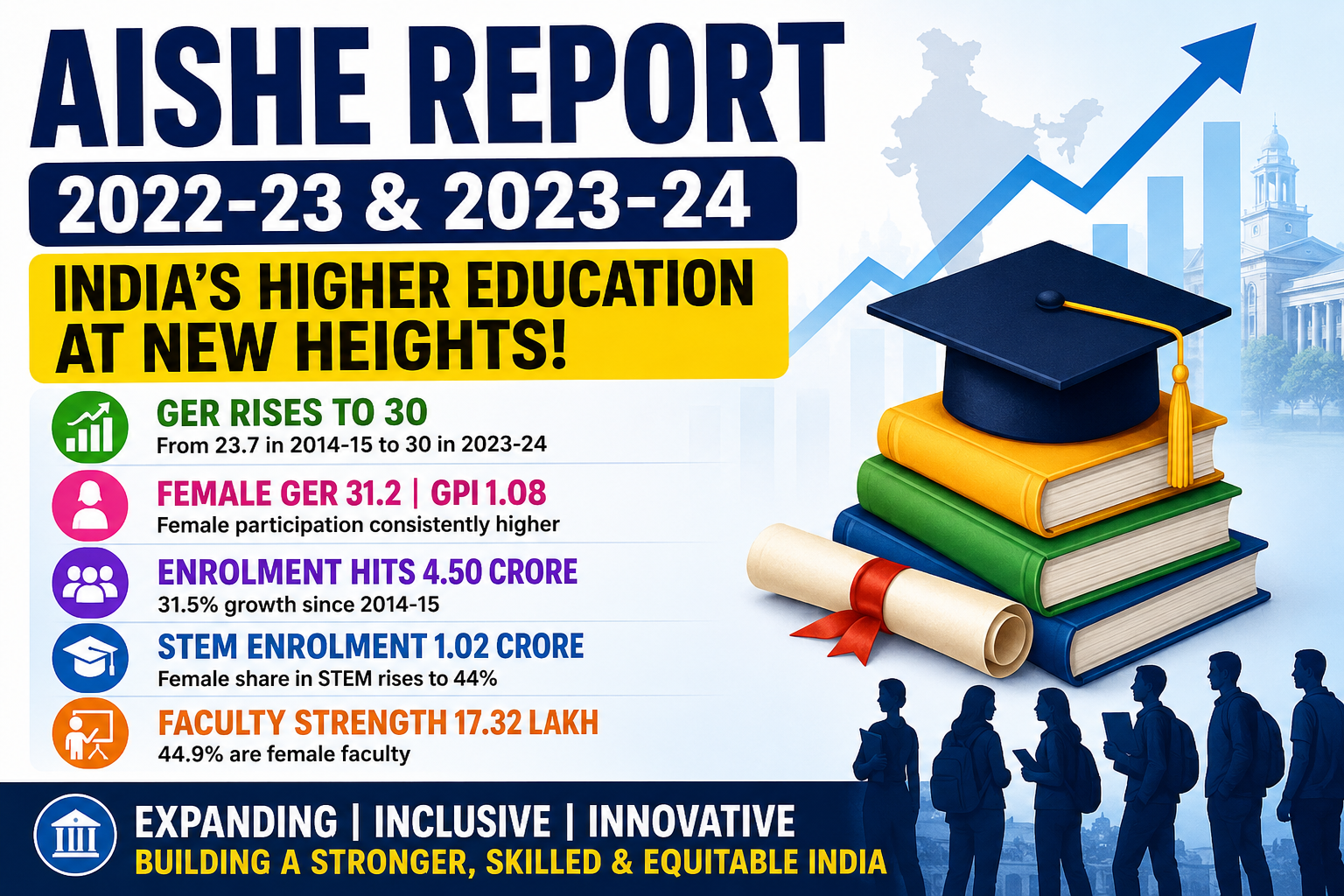
GER increased from 23.7 in 2014-15 to 30 in 2023-24. Female GER rose from 22.9 to 31.2, while GER for Scheduled Caste (SC) students increased from 18.9 to 27.8 and for Scheduled Tribe (ST) students from 13.5 to 22.8 during the same period.
Gender Parity Index (GPI): GPI, the ratio of female GER to male GER, stood at 1.08 in 2023-24 and has remained above 1 for seven consecutive years, indicating consistently higher female participation in higher education.
Higher Education Enrolment: Total enrolment increased by 31.5%, from 3.42 crore in 2014-15 to 4.50 crore in 2023-24.
Female enrolment grew faster by 42.2%, reaching 2.24 crore.
Enrolment of Social Groups: Since 2014-15, enrolment increased by 51.4% among SC students, 75.7% among ST students and 60.2% among OBC students, reaching 69.72 lakh, 28.83 lakh and 1.80 crore, respectively, in 2023-24.
STEM Enrolment: STEM enrolment increased from 91.5 lakh in 2014-15 to 1.02 crore in 2023-24, while the share of female students in STEM rose from 38.4% to 44%, indicating greater gender inclusion. Rising Women’s Share in STEM - Women’s share in STEM enrolment: 44% in 2023-24
Women’s share in STEM enrolment in 2014-15: 38.4%
This represents a significant improvement in gender inclusivity in STEM fields, though further growth is needed to achieve full parity.
Faculty Strength Increases
Total faculty in 2023-24: 17.32 lakh
Female faculty in 2023-24: 7.78 lakh
Female faculty in 2014-15: 5.69 lakh
Rising faculty strength is important for maintaining favourable student-teacher ratios and ensuring quality education.
All India Survey on Higher Education (AISHE)
Background: Initiated in 2010-11, AISHE is an annual, comprehensive, and voluntary survey conducted by the Ministry of Education.
Mandate: It acts as the primary source of official statistics on India's higher education sector, aiding in policy formulation and resource allocation.
Data Collection: It tracks indicators like student enrolment, faculty data, infrastructure, and examination outcomes via a web-based Data Capture Format (DCF).
Limitations of AISHE Data: Participation is voluntary, and data is self-reported by Higher Education Institutions (HEIs). Although the Ministry conducts inbuilt validations, data quality relies heavily on the reporting institutions, and large-scale survey limitations may marginally affect the findings.The survey is a critical policy tool that informs decisions related to higher education planning, financial allocations, and reforms under initiatives like the National Education Policy (NEP) 2020.
Data is submitted voluntarily by registered institutions through a web-based portal and verified using built-in validation checks.
The latest AISHE covers 59,533 higher education institutions with an institutional participation rate of over 90%.
Summary
AISHE Reports 2022-24 highlight significant expansion and inclusion in India’s higher education sector, with rising enrolment, GER, female participation, social-group representation, and STEM education.
Despite quantitative progress, structural challenges persist, including graduate unemployment, skill gaps, faculty shortages, low R&D investment, regional and digital divides, weak institutional autonomy, and uneven quality of education.