4.5/5






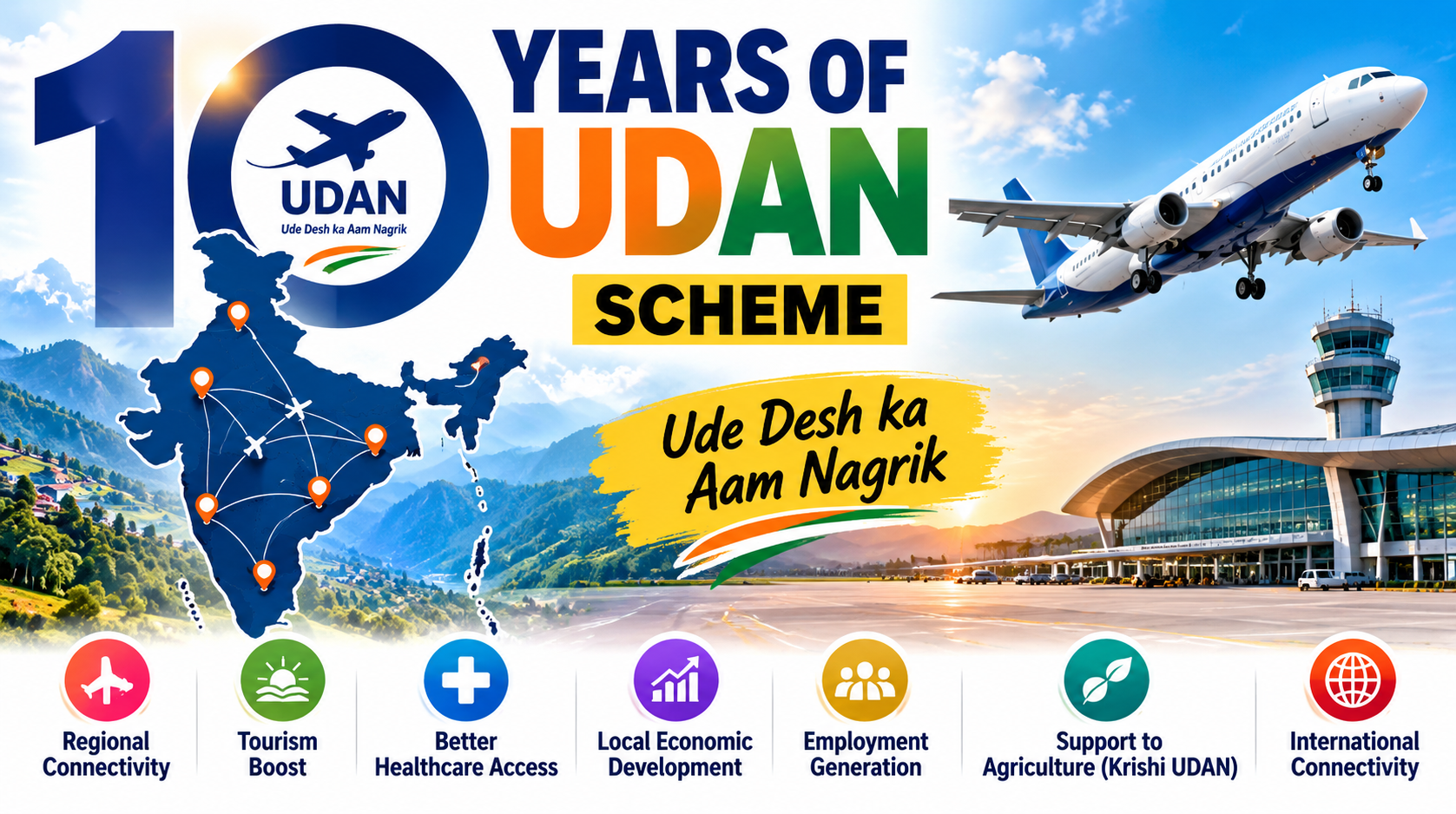
10 Years of UDAN Scheme
The Regional Connectivity Scheme (RCS)-UDAN (Ude Desh ka Aam Nagrik) completed 10 years on 21st October 2026, marking a decade of expanding affordable air connectivity to unserved and underserved regions. The launch of Modified UDAN in July 2026 marks a shift towards sustainable regional aviation, infrastructure development and indigenous aircraft manufacturing.
What are the Key Facts About the UDAN Scheme?
- About UDAN: The Regional Connectivity Scheme (RCS), UDAN, was launched on 21 October 2016 under the National Civil Aviation Policy 2016 to provide affordable and economically viable air connectivity to unserved and underserved regions through financial support and infrastructure development.
- The first UDAN flight was inaugurated between Shimla and Delhi in April 2017.
- It is the flagship scheme of the Ministry of Civil Aviation.
- The Airports Authority of India (AAI) is the implementing agency of the UDAN scheme.
- Ten Years of UDAN: The scheme has contributed to expanding regional connectivity, with India emerging as the world's third-largest domestic aviation market and the number of operational airports increasing from 74 in 2014 to 166 in 2026.
- UDAN Outcomes: The scheme has operationalised 687 regional routes and 95 aerodromes, including 17 heliports and 2 water aerodromes, while facilitating over 3.68 lakh flights and 1.72 crore passengers.
- Financial Support: UDAN uses airfare caps, concessions, market-based selection and Viability Gap Funding (VGF) to encourage airline participation. As of 15th October 2026, ₹5,091.23 crore had been disbursed under VGF.
What are the Key Features of Modified UDAN Scheme 2026?
- Launch and Duration: The Modified UDAN Scheme, launched on 4th July 2026, will be implemented over 10 years (FY 2026–27 to FY 2035–36) with a total outlay of ₹28,840 crore.
- The Union Cabinet, chaired by the Prime Minister, approved the 'Modified UDAN' (Ude Desh Ka Aam Nagrik) scheme on March 25, 2026, to further enhance regional air connectivity across India.
- The Modified UDAN scheme serves as a strategic successor to the original UDAN 1.0 launched in 2016, focusing on the sustainability of routes and reducing the dependency on Viability Gap Funding (VGF).
- A primary objective of this modification is to integrate Advanced Air Mobility (AAM) and electric Vertical Take-off and Landing (eVTOL) aircraft into the regional network to connect remote hilly areas and island territories.
- It introduces a 'Green Aviation' incentive, offering additional subsidies to airlines that deploy aircraft with lower carbon emissions or those powered by Sustainable Aviation Fuel (SAF).
- The Modified UDAN framework aims to operationalize an additional 100 unserved and underserved airports, heliports, and water aerodromes by the year 2030.
Regional Transformation under UDAN Scheme
- Purnea Airport — Bihar (2025)
- Tezu Airport — Arunachal Pradesh (2021)
- Deoghar Airport — Jharkhand (2022)
- Kishangarh Airport — Rajasthan (2017)
Evolution Phases (2016 – 2026)
• UDAN 1.0 (2017): Focused on connecting unserved and underserved regional airports with capping fares; first flight operated between Shimla and Delhi in April 2017.
• UDAN 2.0 (2018): Expanded the scope to include helipads for remote and hilly areas.
• UDAN 3.0 (2018–2019): Added tourism routes, seaplanes, and water aerodromes.
• UDAN 4.0 – 4.1 (2020–2021): Deepened connectivity in North-Eastern states, island territories, and hilly regions.
• UDAN 5.0 – 5.5 (2023–2025): Focused on unconstrained caps on Viability Gap Funding (VGF), smaller aircraft categories, and diversified last-mile connectivity.